

Mercedes-Benz is building PLM.AI, an AI-native digital backbone for product lifecycle management. It links development, procurement, production, sales and after-sales through one intelligent knowledge base.
The company aims to reduce development time by up to 30 percent and sees efficiency gains of up to 50 percent in individual engineering processes.
Board member Jörg Burzer, who oversees development and procurement as Chief Technology Officer, said the system will make the company faster, more connected and better at learning, while quality and safety standards stay the same.
From Isolated AI Tools to a Connected Thread
AI agents already support tasks ranging from material cost optimisation and homologation to fault detection and software development, but mainly within single process steps. PLM.AI connects those applications through standardised data models and end-to-end integration of development data.
The result is a digital thread with real-time information and simpler coordination. Mercedes-Benz describes the project as an investment of around half a billion euros.
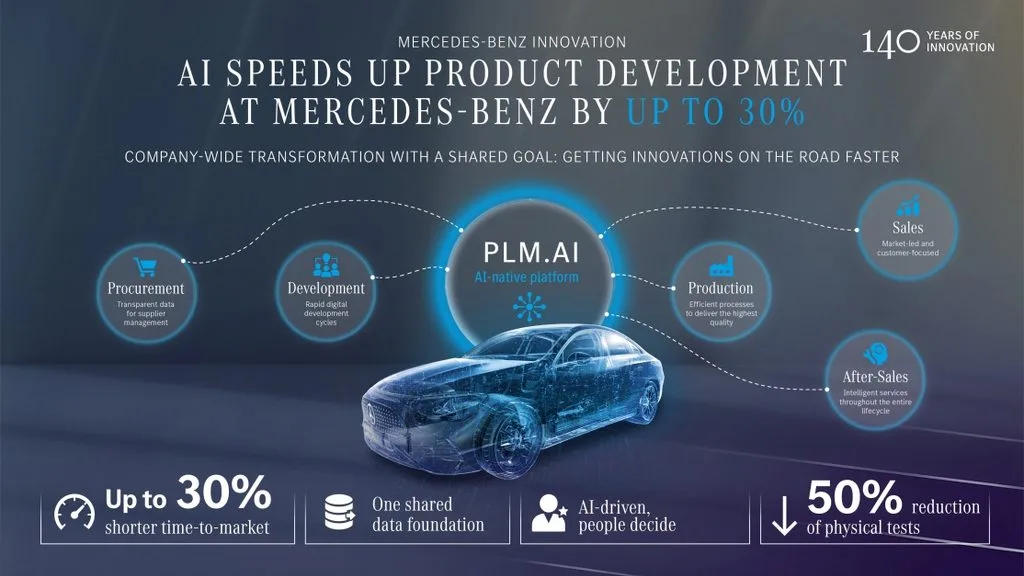
The company says AI-powered simulation should allow more targeted physical testing, and it aims to cut physical testing by half over time. Responsibility for product decisions stays with the teams. Weight optimisation illustrates the approach: a change to one component affects cost, crash behaviour, hardware, software and production.
Specialised AI agents are designed to analyse those interdependencies together, so teams see the full picture earlier. Product, service and operating data also open new possibilities in after-sales.
Partners and Ownership
CONTACT Software supplies the open PLM core layer through CONTACT Elements, giving Mercedes-Benz a modular and scalable base for product data, processes and future AI tools. Siemens contributes AI-enabled automotive design, simulation and digital validation for the digital twin.
Mercedes-Benz leads the transformation itself, setting the target vision, architecture, data models and governance, and managing global rollout through an agile programme. The company says it retains full ownership and control of its data and of the AI models built on that data.