
Hyundai Motor used its 2026 CEO Investor Day to reaffirm its goal of 5.55 million global vehicle sales by 2030, representing 6% global market share, while raising its electrification target so electrified vehicles make up 60% of sales by then, up from 23% in 2025.
President and CEO José Muñoz framed the plan around Hyundai’s financial position, noting the company’s status as the third-largest and second-most-profitable automotive group gives it room to invest while rivals pull back, pointing to over 100 new models arriving by 2030, an operating margin target raised above 9%, and a broader push to become what he called a physical AI company producing robots and robotaxis.
The plan builds on solid first-half 2026 results, with two million wholesale units sold, revenue of 95.2 trillion won (up 2.7% year-over-year), and a 5.6% operating margin.
A Global Product Offensive
Hyundai plans to launch or refresh more than 100 vehicles by 2030 — 58 in North America, 49 in Korea, 41 in Europe, 26 in India and 22 in China — with seven new models arriving in the next eight months alone, including an all-new Elantra, IONIQ 3, Tucson and Tucson Hybrid, and new SUVs for India and Europe.
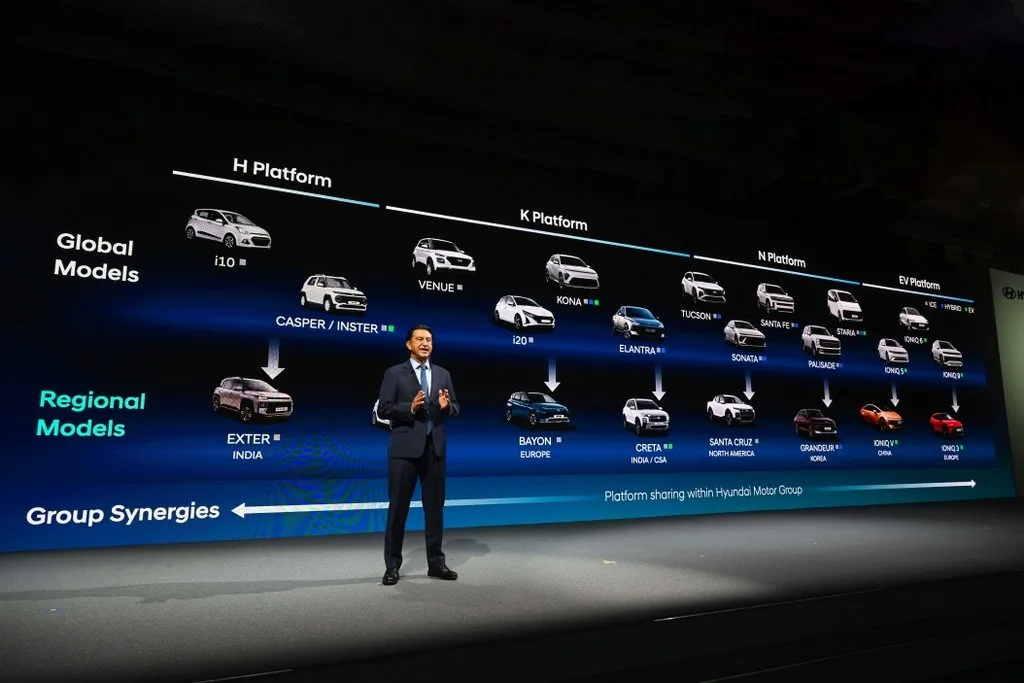
The redesigned Tucson, Hyundai’s best-selling nameplate with more than 10 million cumulative sales, launches in initial markets in the fourth quarter.
Hyundai is also targeting “white space” segments where it’s currently underrepresented — including body-on-frame vehicles, a midsize pickup and light commercial vehicles — which the company says account for roughly 29% of total industry sales, while its N performance lineup works toward 100,000 annual sales by 2030 alongside a new volume-oriented high-performance tier.
Extended-Range EVs Enter the Lineup
Hyundai’s first Extended Range Electric Vehicles (EREVs) arrive starting in the first half of 2027, combining EV-like driving dynamics with a smaller battery and an onboard charger to target more than 600 miles of total range.
The first will be a Santa Fe EREV built at Hyundai Motor Manufacturing Alabama, aimed directly at customers still hesitant about charging and range. Genesis will follow with its own EREV SUV targeting over 640 miles of range in early 2027, alongside the brand’s first hybrid, the GV80 Hybrid, launching in the fourth quarter.
Expanding Manufacturing Around the World
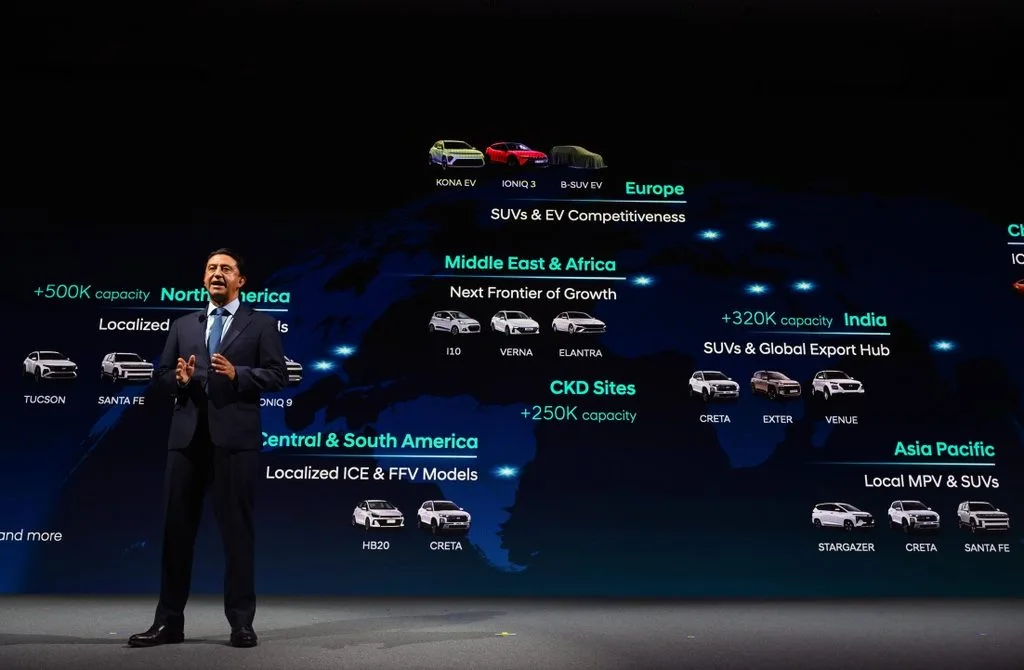
Hyundai plans to add 1.27 million units of global manufacturing capacity by 2030, split across North America (500,000 units), India (320,000), CKD sites (250,000) and Korea (200,000).
In North America, the company is raising its 2030 local parts-sourcing target from 60% to 80% and plans more than 10 hybrid models built at its Alabama and Metaplant America facilities, with hybrids reaching half of regional sales; North American sales already hit a record first-half total of 595,457 units, while U.S. deliveries rose 3% to 489,656 units.
In Europe, Hyundai aims to cover 85% of the market with electrified options and grow EV sales to more than 420,000 units by 2030, starting with the new IONIQ 3, which launches this month with 309 miles of range and Hyundai’s first European rollout of its Pleos Connect infotainment platform.
India gets a new electric SUV in the fourth quarter plus a new ICE midsize SUV, backed by a push to source 90% of vehicle content locally by 2030, while Korea’s plants — producing around 1.8 million vehicles annually — will add a new software-defined EV facility in Ulsan that starts production with the Genesis GV90.
In China, Hyundai is targeting a turnaround built around local partnerships and new EV and EREV launches starting with the IONIQ V, aiming for more than 500,000 units of sales by 2030.
Genesis Opens a New Decade
Having become the fastest luxury brand in history to reach one million cumulative sales, Genesis is targeting more than 40 markets, 350,000 annual sales and over 270 retail locations by 2030.
The new GV90 flagship SUV anchors that push alongside the brand’s new hybrid and EREV powertrains, with Spain set to become the brand’s fifth new market activation of 2026 following recent launches in Italy, France, the Netherlands, Tunisia and Morocco.
Robotics, Robotaxis and New Partnerships
Hyundai’s robotaxi push begins with Waymo-bound IONIQ 5 deliveries in the fourth quarter, built at HMGMA in Georgia, with international expansion of robotaxi services targeted as early as 2027 and a driverless Motional service launching later this year on the same platform.
The company is also entering the electric three-wheeler segment with TVS Motor Company and deepening a four-part partnership with Amazon spanning Amazon Autos, Alexa integration, AWS cloud infrastructure and potential fuel-cell vehicle use in warehouse operations.
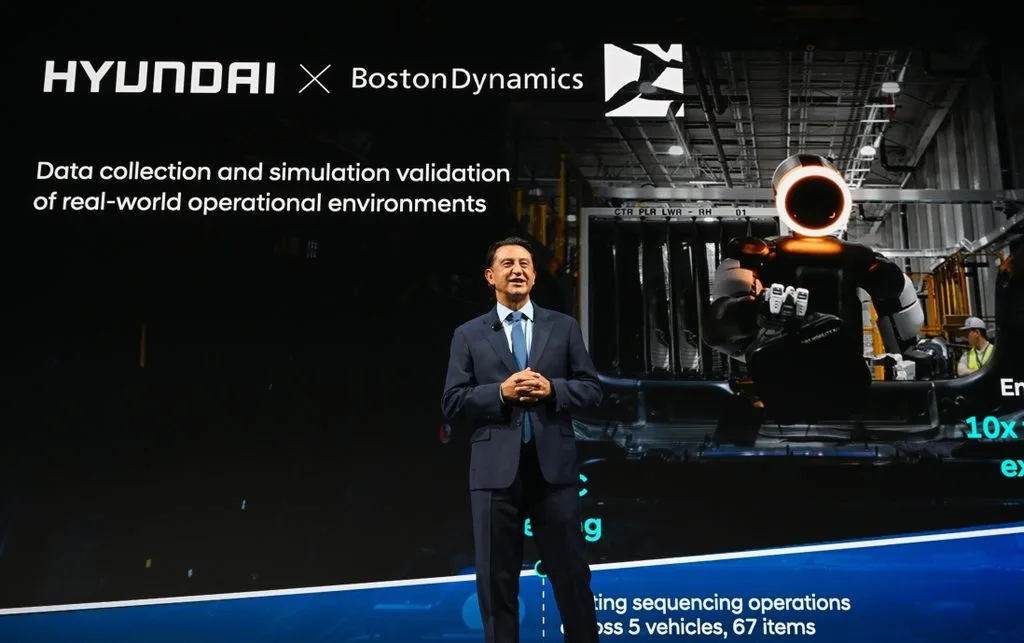
On the robotics side, Hyundai’s Boston Dynamics-developed manufacturing robots are moving toward commercialization through its Robot Metaplant Application Center, which opened in June and will expand tenfold by year-end, with the humanoid robot Atlas targeted for deployment at Metaplant America starting in 2028.
Muñoz described the opportunity as spanning the group’s full capabilities — development, production, distribution, sales and financing — all under one roof.
Software, Data and a Staged Path to Autonomy
Hyundai is building what it calls a data flywheel connecting vehicle data collection, AI analysis and over-the-air updates, already live through the Pleos Connect infotainment system and Gleo AI assistant debuting on the refreshed Grandeur.
That same approach extends to autonomous driving, with Hyundai standardizing sensor architecture around Nvidia’s platform so data from Hyundai, Kia, 42dot and Motional can feed a single system.
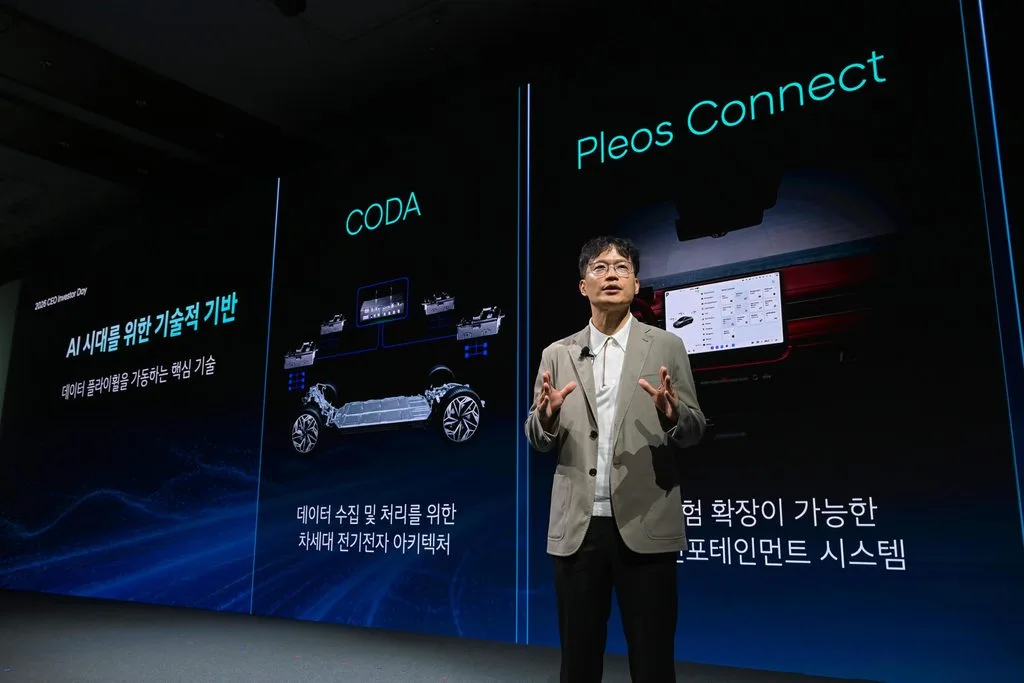
The autonomous roadmap starts with real-world data collection in Gwangju this year through the company’s Atria AI system, followed by Level 2+ capability on its first mass-produced software-defined vehicle in 2028 through the Nvidia partnership, with a 100-megawatt, 50,000-plus-GPU data center in Saemangeum coming online from 2029 to support the buildout toward Level 4 autonomy.
Battery Advances and a Higher Profit Target
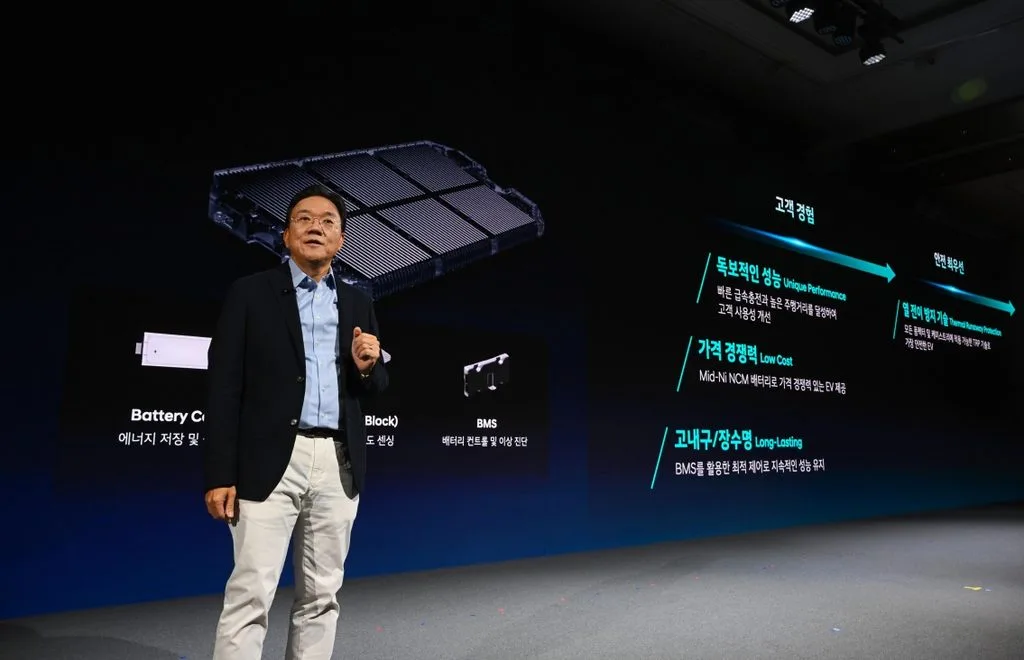
Hyundai’s newly developed in-house battery cells more than double the output of its previous high-nickel cells while cutting charging time by 40%, with a new Thermal Runaway Protection system — debuting on the Genesis GV90 — designed to block heat transfer between cells during a battery fire rather than merely delaying it.
Financially, Hyundai raised its 2030 operating margin target to above 9%, up from the previously guided 8-9% range, supported by a 3-percentage-point reduction in its cost of sales ratio, while maintaining 2026 guidance of 6.3-7.3% and continuing its existing shareholder payout policy, now renamed from Total Shareholder Return to Total Payout Ratio.