

Designers rarely get every shape they draw into production. Sheet steel can only stretch so far before it tears.
Three press-forming engineers explained how Hyundai handled that limit on the All-New Tucson: Choi Su-young of the Forming Verification Advanced Production Engineering Team, and Kwon Yong-wook and Hong Gyu-seon of Hyundai Forming Development Team 1. Hyundai chose not to tone down the design. Instead, it ran at least three times more forming simulation and verification than on other models.
How much bigger are the All-New Tucson’s rear fenders?
Rear fender volume is up 20%, and the area of the fender that sticks out when viewed from behind is also 20% larger.
On the side outer panel, the forming angle changed from 39.5 to 26.5 degrees, about 13 degrees steeper, and draw depth increased from 40mm to 71mm. Early simulations showed cracks where the steel stretched too much and wrinkles where it bunched up, both in the same area.
How did Hyundai fix cracks and wrinkles at the same time?
Hyundai combined multi-directional tension control with multi-stage forming.
Concave tension features at the rear quarter glass and rear door opening pull the steel at the exact moment wrinkles start to form. Multi-stage forming shapes the panel in steps to reduce strain and prevent cracking.
Engineers also flattened the rear door opening, adjusted the door step, and added a glass division channel. That let them move the door opening forward and make room for more fender volume.
Why was the hood just as hard?
The extended clamshell hood has 50% more volume on each side and is 15% longer, which made it as hard to form as the side outer panel.
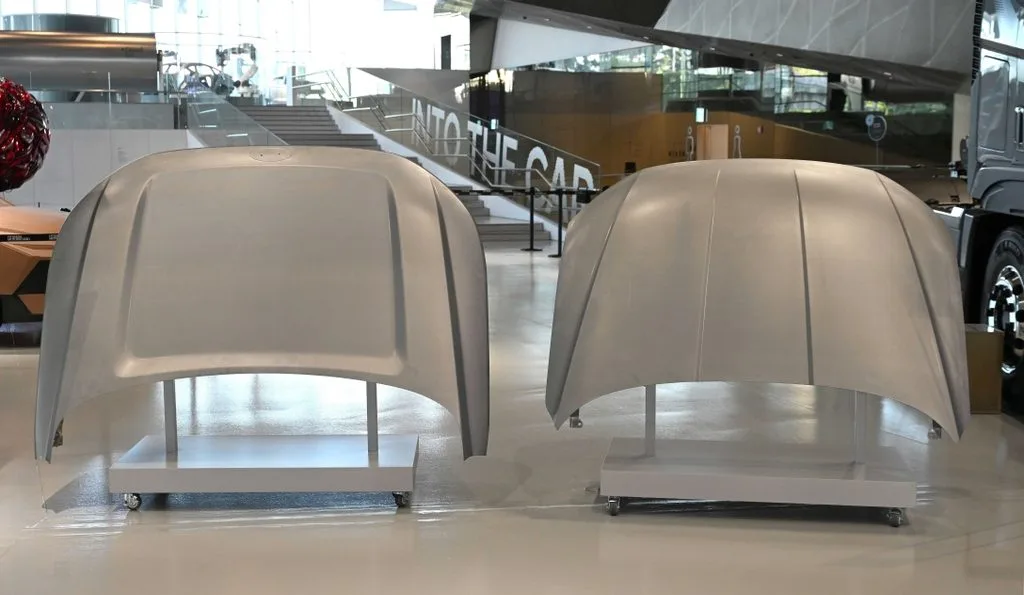
The panel’s parting line moved from the top to the sides, and the hood now covers the area around the A-pillar. The first prototype panels cracked near the windshield. When engineers let more steel flow in, distortion got worse elsewhere.
The fix was “pre-shape control.” Adding a temporary convex shape delays when the problem area touches the die, so the distortion settles out as the panel reaches its final shape. Reverse skin compensation and tuned press pressure took care of what was left.
What is unit-cam hemming?
Unit-cam hemming applies pressure along the direction of the panel surface, which allowed Hyundai to finish the hood’s almost-vertical cowl sides.
Standard hemming tools press only straight up and down and couldn’t hold quality on that shape.