
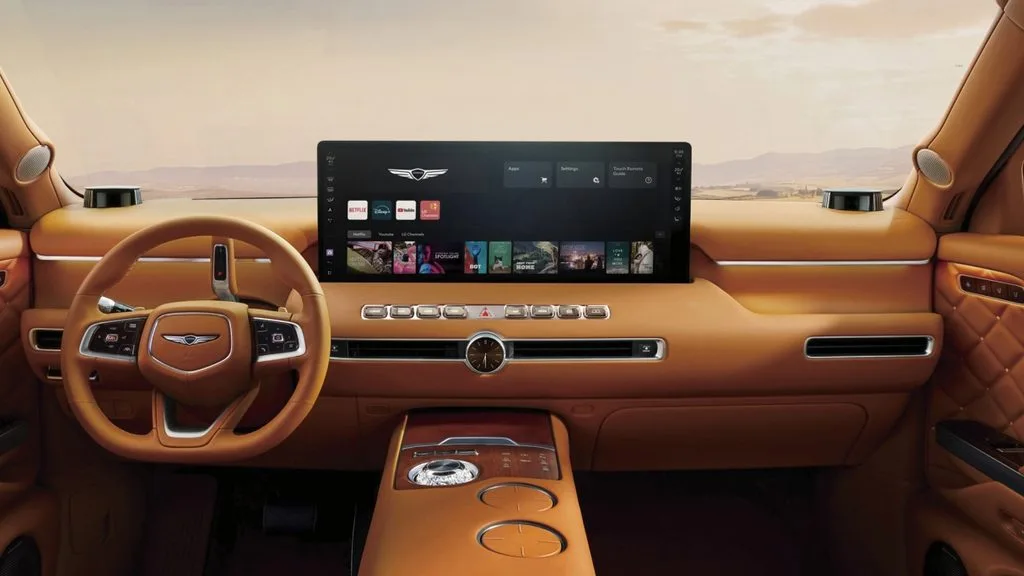
The pop-up OLED Cinematic Display on the Genesis GV90 grew out of a simple premise: that a parked electric vehicle can keep powering features and become something closer to a private theater than a stationary car.
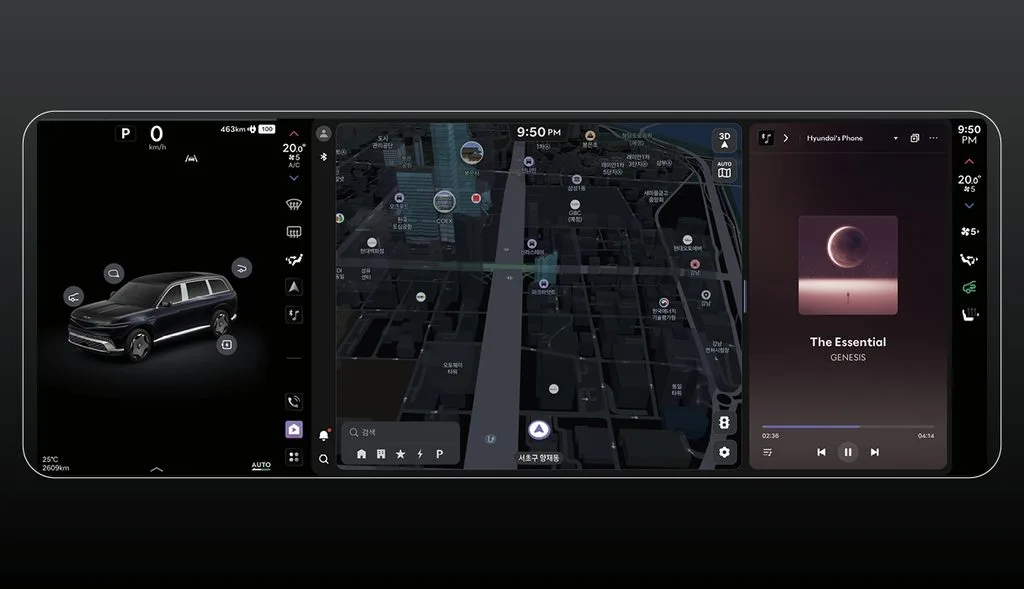
The GV90 is the first Genesis model to run Pleos Connect, Hyundai Motor Group’s next-generation infotainment platform, built specifically to work alongside the pop-up display. While driving, the screen operates as a 23.6-inch wide display showing vehicle information, navigation and media, paired with a 25-inch head-up display projecting speed, navigation and ADAS status directly in the driver’s line of sight, alongside the Gleo AI voice assistant for hands-free control.
Once parked, pressing the extension button on the center fascia raises the screen 90mm to reveal a full 24.6-inch display measuring 584.1 by 219 millimeters — about 1.7 times the viewing area, at a 3840×1440 resolution — accompanied by an animation that reinforces the sense of transformation.
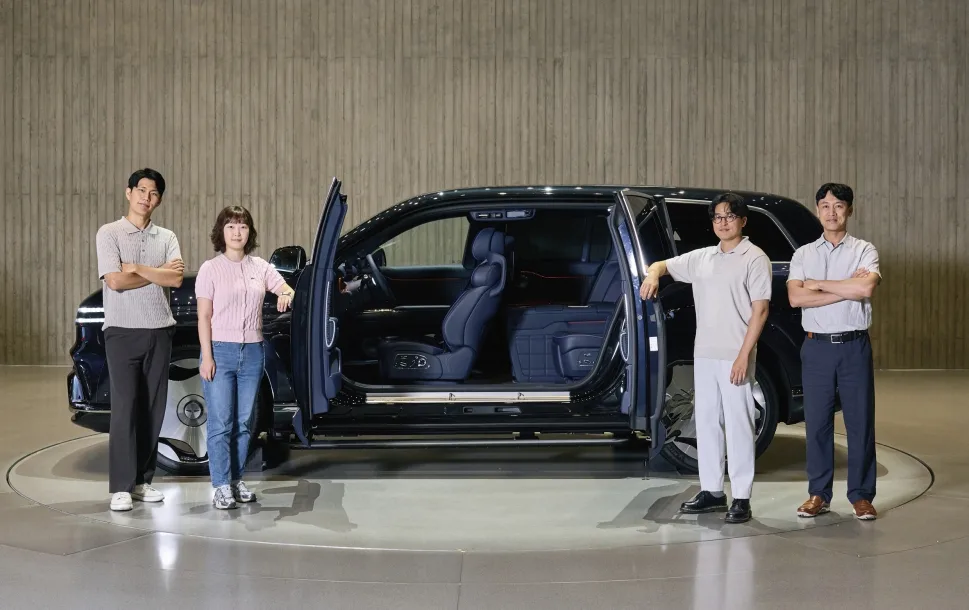
Senior Research Engineer Inho Yoon, who helped define the system’s development concept, said the team wanted the extended display to function like a home theater, switching into a “Media Home” mode that mirrors a smart TV experience with access to streaming and live channels.
Engineering a Pop-Up Mechanism That’s Silent and Durable
Bringing that pop-up function to life fell to Senior Research Engineer Jongkyo Ahn of the Infotainment Device Engineering Team, who focused on the mechanism’s performance and quality from the earliest stages of development.
Adding a motor, gears and guide rails to enable the pop-up motion introduced extra weight that risked vibration under conventional mounting, so Ahn’s team instead mounted the display directly to the cowl crossbar — a structural component that helps prevent chassis flex — while coordinating closely with interior design and packaging teams to avoid interference from the display’s movement.

The mechanism itself relies on a linear motion guide to keep the display moving in a straight line, a rack-and-pinion gear to convert the motor’s rotation into vertical motion, and a brushless DC motor to drive it upward, together enabling smooth, quiet operation.
Ahn said the system completed more than 100,000 test cycles while keeping operating noise below 40 decibels across low, ambient and high-temperature conditions — roughly library-quiet — including testing in a chamber cooled to -30°C. For safety, the extended display automatically retracts once the vehicle starts moving, both returning to its driving-focused layout and avoiding any interference with front passenger airbag deployment given its size.
Designing an Intuitive, Multitasking-Friendly UX
Software shapes how occupants actually experience that hardware. Senior Research Engineer Mina Lee of the Infotainment UX Development Team led UX design for window behavior, common specifications and the menu bar, with a particular focus on letting navigation run smoothly alongside other apps.
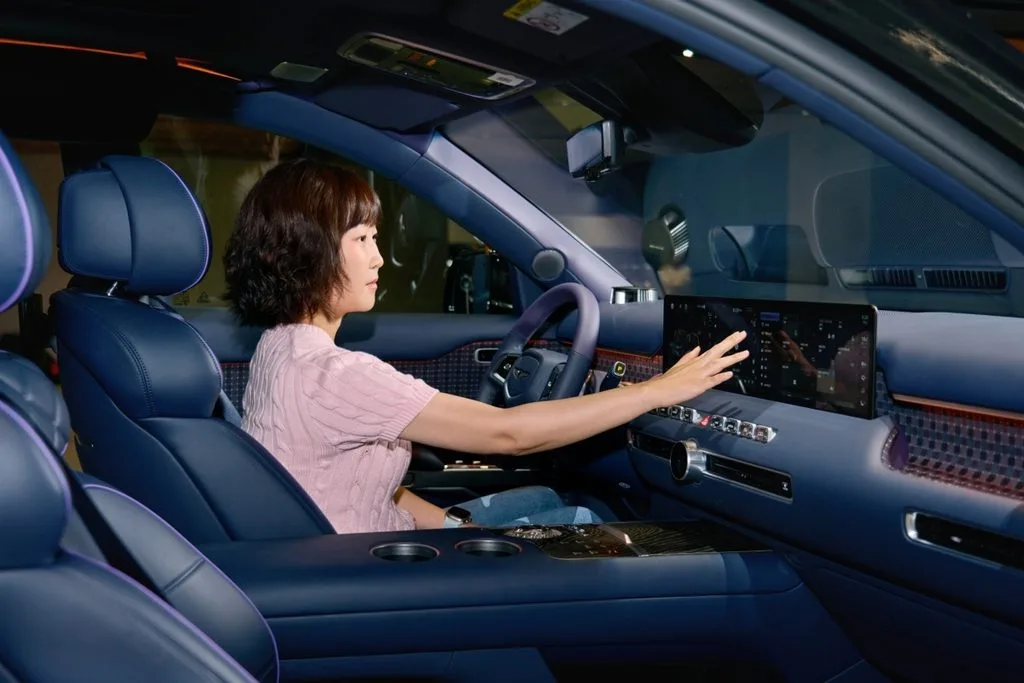
Despite working with an entirely new vehicle interior, Lee’s team aimed for a core interaction flow that felt familiar from smartphones, reasoning that safety and intuitive use should hold up regardless of how devices evolve. The layout keeps navigation central even during multitasking, minimizes driver distraction, and uses clear resizing graphics so drivers understand adjustment limits at a glance.
Unlike earlier Pleos Connect versions, the GV90 splits its menu bars across both sides of the screen — the driver’s side handling climate, navigation and app shortcuts, the passenger’s side covering climate and heated-seat controls — cutting down on unnecessary eye movement.
The head-up display, roughly twice the size of previous systems, adds information like estimated range and drive mode status in a dedicated notification area that doesn’t crowd out core driving data, while Yoon noted that consolidating information, controls and function status onto one screen lets drivers stay focused without looking away.
Additional convenience touches include a new “APPS” button above the integrated Crystal Sphere Controller for direct access to the app menu, and a physical vehicle-settings button that opens a Quick Control page gathering frequently used functions in one place — with the team continuing to explore further shortcuts and more personalized menu options.
A Distinctly Genesis Look and Feel
Senior Research Engineer Sooyul Bae of the Infotainment UX Development Team set the design standards governing screen layout and graphics, working with UX and GUI specialists to keep pop-up window placement, button shapes and overall composition consistent across the interface.
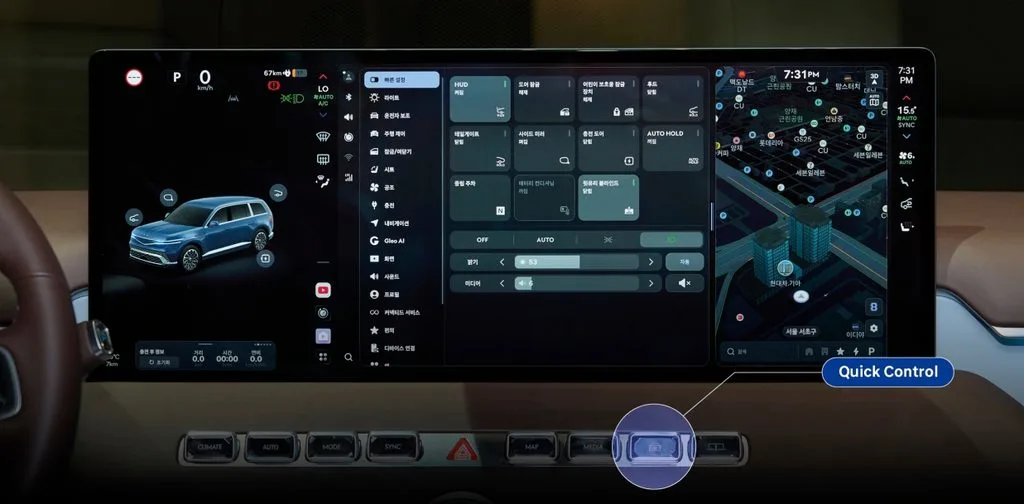
Bae described the core challenge as presenting comprehensive information without losing Genesis’s sense of restrained luxury, an approach reflected in a dedicated typeface, rounded-square windows and icons meant to feel solid yet refined, and a mostly neutral color palette that reserves accent colors for genuinely important information.
Bae summarized the philosophy as focusing on what to leave out rather than how much to show, aiming for a relaxed, sophisticated feel distinct to Genesis. That same sensibility carries into the physical controls, including real-glass crystal buttons and a Center Knob Display for volume, temperature and fan speed, alongside a 25-speaker Bang & Olufsen Premier 3D sound system that reinforces the display’s sense of immersion.
Built for System Stability
Given the display’s size and range of functions, the GV90 runs its instrument cluster, head-up display and center display through a single control unit designed around stability, shifting more processing resources toward driving functions while in motion and toward entertainment features once parked with the display extended.
Yoon said the team specifically optimized resource allocation to avoid delays from unnecessary usage while also building in long-term reliability.
A Project Defined by “Customer”
Both Bae and Yoon described the project as genuinely uncharted territory, requiring extensive coordination across teams to define standards that didn’t exist before while keeping the experience consistently Genesis.
Across conversations with all four engineers, the word that came up most wasn’t hardware or software, but customer — a reminder that the display’s real purpose was always the experience behind the screen, not the screen itself.