
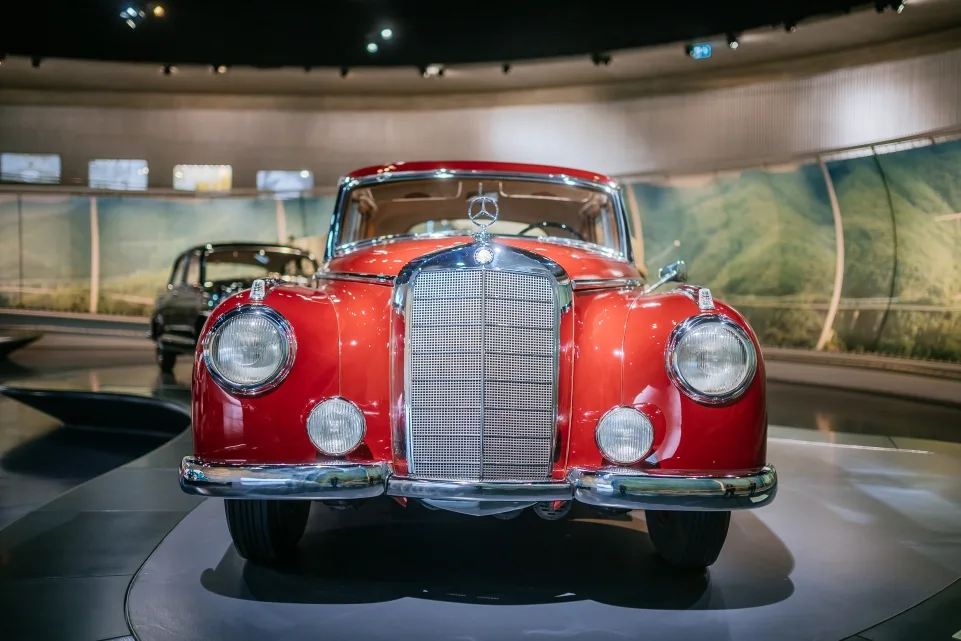
The Mercedes-Benz Museum‘s “Close-up” series features the Mercedes-Benz 300 prestige saloon in Legend Room 4, dedicated to the post-war period from 1945 to 1960 titled “Post-war Miracle – Form and Diversity.” The exhibition incorporates rock ‘n’ roll music recreating the 1950s atmosphere of emerging freedom and growing prosperity.
Unveiled 75 years ago, the Mercedes-Benz 300 made what the museum characterizes as a powerful statement during Germany’s economic miracle period. The displayed vehicle features brilliant red exterior paint and imposing physical dimensions representing the model series’ spacious comfort, poise, assurance, and social aspirations associated with ownership.
Interior Craftsmanship Established Engineering Benchmark
The spacious saloon earned recognition as Germany’s automotive engineering benchmark upon its 1951 premiere. Interior construction combined high craftsmanship with quality materials—an approach the museum notes continues characterizing Mercedes-Benz customization offerings today.
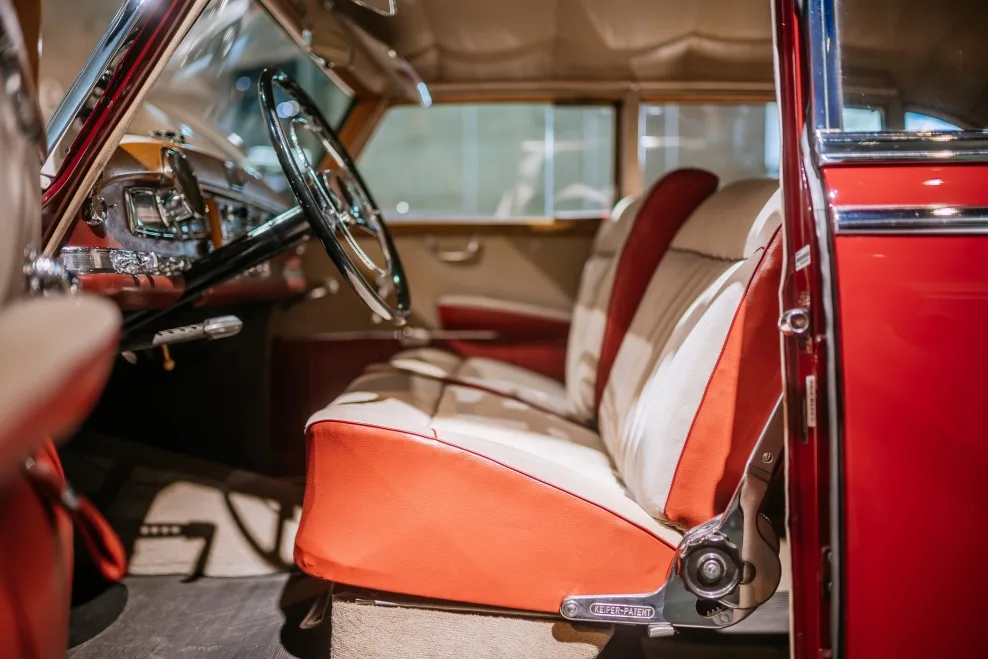
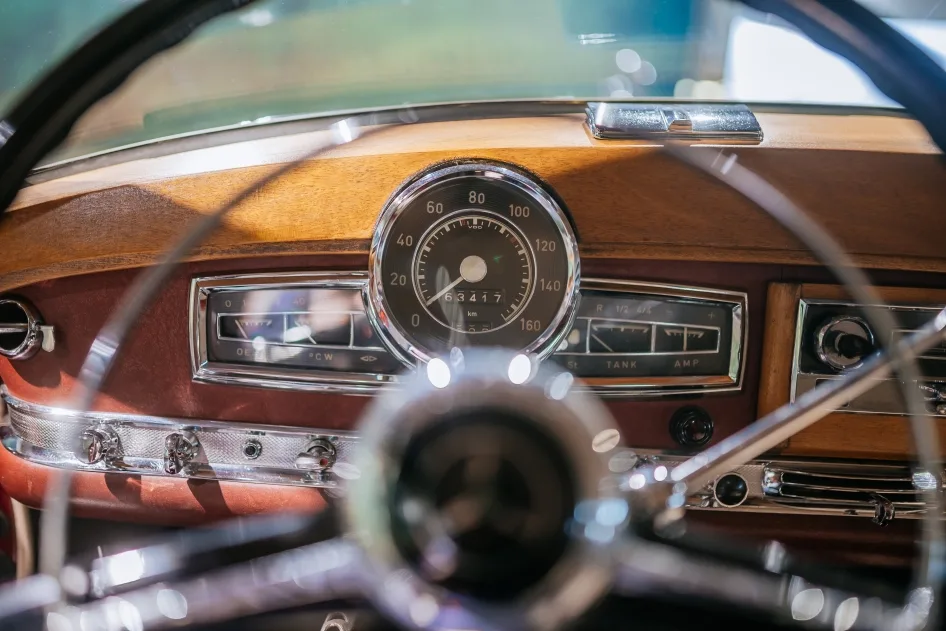
Grey-red upholstery described as pleasantly firm yet comfortable combines with fine fabric and imitation leather finishing on interior door paneling. Dashboard and window surrounds feature wood finishing, while most controls employ chrome plating extending to Becker Nürburg car radio buttons. Other controls utilize black or ivory-colored plastic knobs.
The steering wheel incorporates a large plastic-encased rim with chrome-plated indicator and horn ring. The speedometer scale reaches 160 km/h. With 85 kW (115 hp) output and 155 km/h top speed, the Type 300 offered performance appealing to both luxury car owners and their chauffeurs.
The Keiper-patented adjustable driver’s seat provided comfort through Fritz Keiper’s tilting backrest mechanism, enabling individual adjustability. Fritz Keiper’s soft top and fittings factory began developing automotive industry solutions during the 1920s. A rear-view mirror mounted on the left wing sits on a curved chrome base.
Distinctive Styling and Color Specification
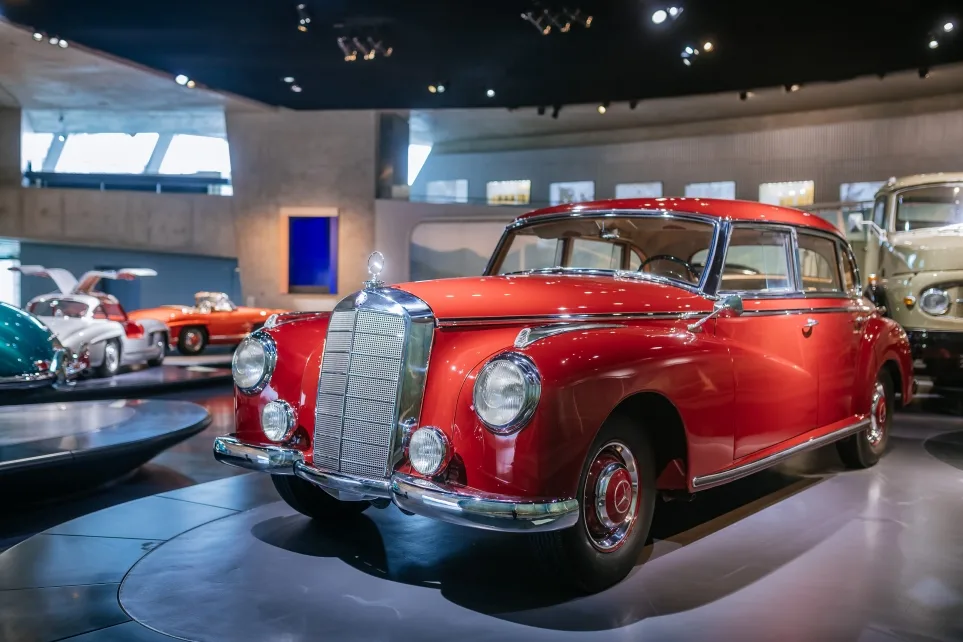
Stylists and bodywork specialists created what the museum describes as elegant and prestigious shaping across all details. Autocar magazine praised the prestige saloon in February 1952, noting Mercedes-Benz bodywork produced at the Sindelfingen coachbuilding works demonstrated “continuity of style, combined with an unpretentious distinction of line.”
Design elements included extending the wing’s sweeping curvature into front doors. Chrome strips on front wings terminated in clear rather than yellow-colored indicator glass—an unusual 1950s detail. The medium red paint (color code DB 516) creates attractive contrast with chrome details and makes this particular 300 rare, as most production vehicles were delivered in muted colors.
Technical Specifications and Market Positioning
When built in 1952, this Mercedes-Benz 300 represented the brand’s top-of-the-line model and Germany’s largest and fastest series-produced automobile. The museum characterizes the combination of sophisticated powertrain, comfortable and safe chassis, refined ambience, and numerous amenities as representing maximum achievement for the period.
The rear features a large boot accommodating bulky luggage with low loading sill. Spare wheel bays occupy left and right positions. The type designation 300 appears discreetly on the lower boot lid edge, framed by two horizontal chrome strips with fine cross ribs connecting digits.
The prestige saloon shared the 300 designation with other Mercedes-Benz models powered by the three-liter six-cylinder inline engine: 300 S Coupé, Cabriolet and Roadster (W 188, 1952 to 1955) and 300 SL (W 198, 1954 to 1963).
Model Evolution and Political Association
Mercedes-Benz continuously developed the 300 across four variants in two model series: W 186 with carburetor engine (1951 to 1957) and W 189 with intake manifold injection (1957 to 1962). Road & Track magazine stated in June 1954 that within three years, this largest and most luxurious Daimler-Benz model had “established a top reputation among the elite of motor cars.”
Ownership or chauffeur-driven use demonstrated business success or political status. Konrad Adenauer, first Chancellor of the Federal Republic of Germany, maintained particularly well-known association with the Mercedes-Benz 300. The CDU leader used six such vehicles during his term ending in 1963, retaining the final vehicle as private transportation. That vehicle also appears in the Mercedes-Benz Museum’s Collection Room 4: Gallery of Celebrities.
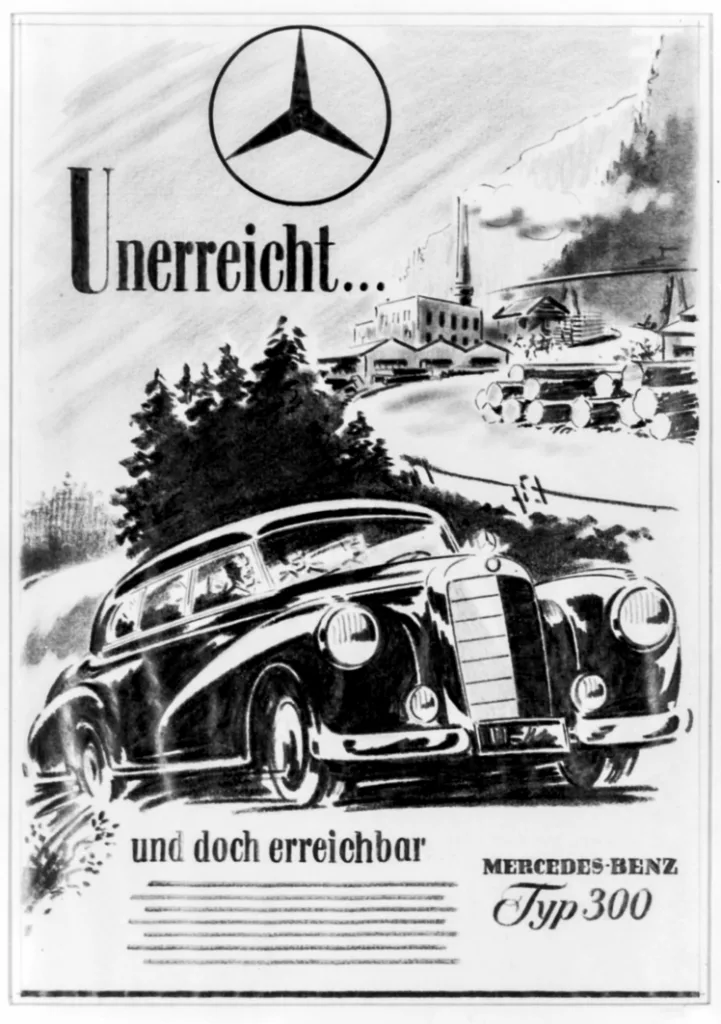
Mercedes-Benz advertised the 300 in the early 1950s as “Unrivalled… and yet attainable,” positioning the message as advancement promise for private customers. The red saloon was delivered in Mainz from 1952, potentially representing what the museum describes as a “real economic miracle car” for its owner during the reconstruction period.