
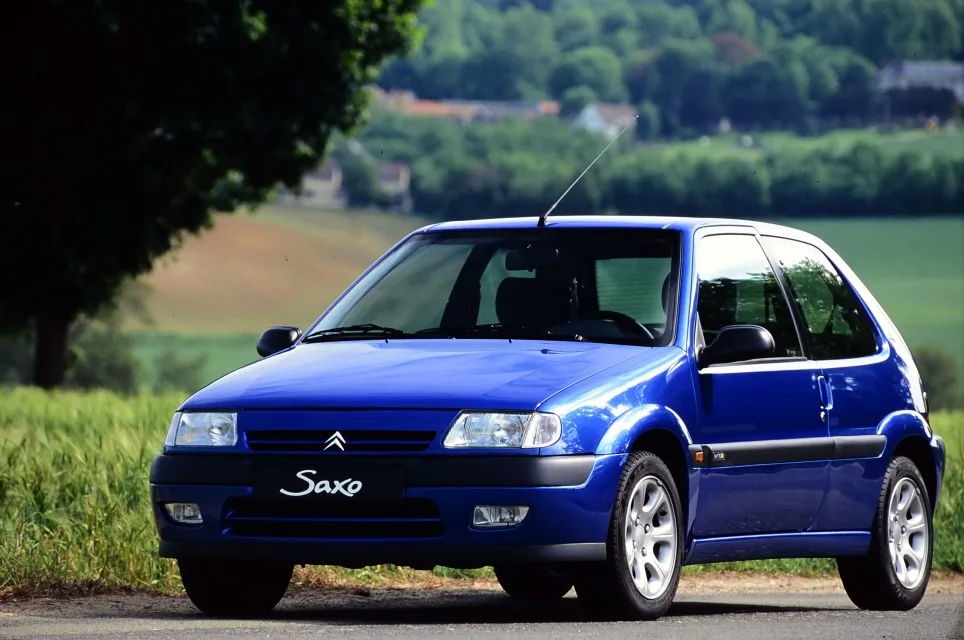
Citroën is commemorating the 30th anniversary of the Saxo VTS, a model the French manufacturer characterizes as delivering accessible motorsport-inspired performance to driving enthusiasts.
Introduced in February 1996, the vehicle represented Citroën’s interpretation of a road-going kart—emphasizing reliability, affordability, and driver engagement over luxury or technological complexity.
The Saxo VTS emerged from a lineage established by the AX, which Citroën launched in 1986 to compete in the sporty city car segment. The AX Sport and AX GTi variants built reputation through handling precision and favorable power-to-weight ratios, creating market expectations for a successor model with similar characteristics.
Design Evolution and Power-to-Weight Engineering
While Italian designer Donato Coco shaped the standard Saxo’s overall aesthetic, Citroën assigned the performance variant’s body kit development to Gilles Vidal, then a novice designer in 1996.
His debut project involved creating integrated fender flares that merged seamlessly with rocker panels and widened bumpers, with rear extensions running from wheel arches to door cutouts beneath protective trim.
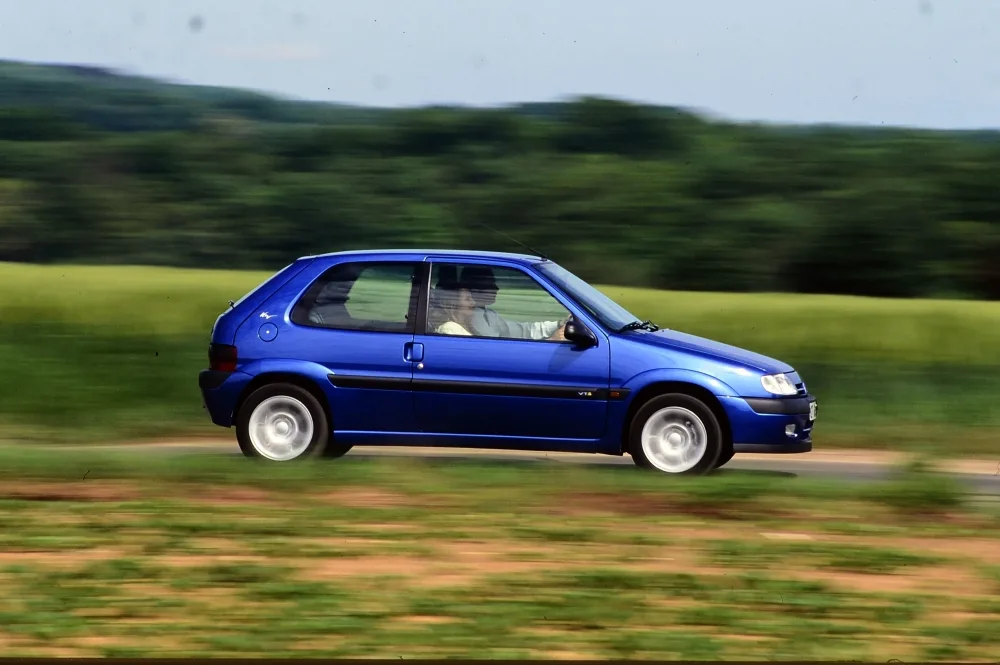
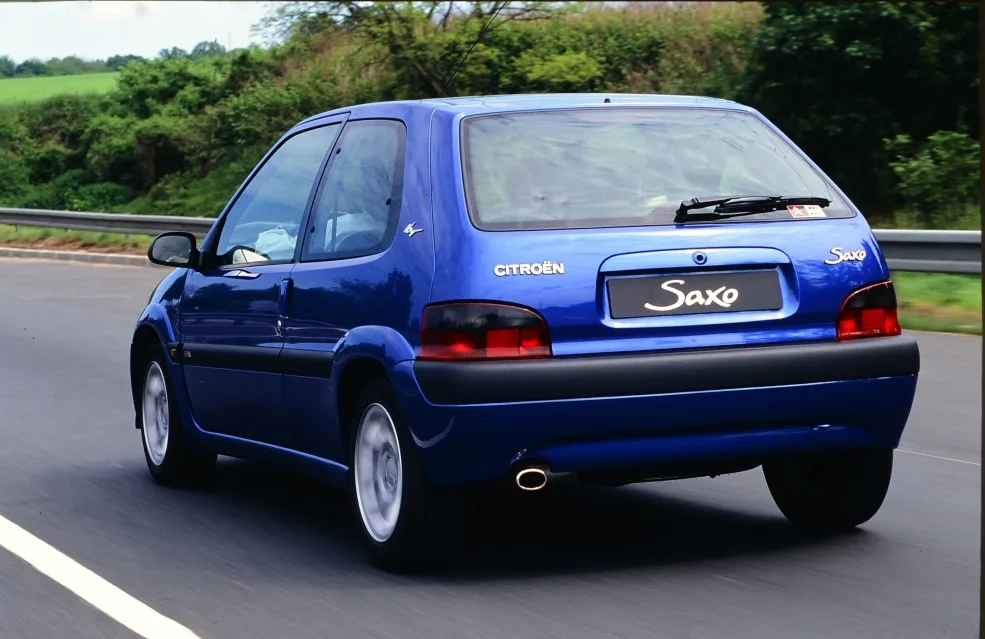
The VTS employed deliberately understated visual cues—16V badges on rear fenders, chrome exhaust tips, and distinctive alloy wheels—masking its mechanical capability.
The TU5J4 1.6-liter 16-valve engine produced 120 horsepower at 6,600 rpm with a 7,300 rpm redline. Combined with a five-speed transmission featuring shorter final drive gearing and a 935-kilogram curb weight, the configuration enabled 205 km/h maximum velocity and sub-30-second 0-100 km/h acceleration.
Chassis tuning prioritized precision front-end response, calibrated power steering assistance, and rear-end dynamics designed to provide controlled oversteer characteristics when driven aggressively. Ventilated front disc brakes complemented the performance-oriented suspension setup.
Product Line Expansion and Aesthetic Refresh
By late 1997, Citroën reorganized its sporty model hierarchy, with the 16-valve variant reclaiming badging previously used on the ZX model. This reorganization enabled broader VTS designation application across multiple powerplant options, expanding market reach beyond pure performance buyers.
The VTS range incorporated 90-horsepower 1.6i engines previously exclusive to VTR models, alongside 100-horsepower 1.6i and 75-horsepower 1.4i variants. These additions provided VTS styling and suspension refinement to customers prioritizing appearance over maximum output.
A comprehensive 1999 facelift introduced almond-shaped headlamps, a domed hood profile, and an enlarged chevron grille, modernizing aesthetics while preserving mechanical character. Production continued at the Aulnay-sous-Bois facility through June 2003, when the C2 succeeded the Saxo after seven production years.
Competition Framework and Driver Development
Citroën Sport constructed a comprehensive racing infrastructure around the Saxo VTS platform, establishing multiple series including Saxo Cup, Saxo Challenge, Saxo Rallycross, and Saxo Glace. These competitions employed varied regulations designed to maximize accessibility for entry-level racers.
Notably, series technical regulations mandated production engine usage, demonstrating the chassis’s inherent competitive capability without extensive powertrain modification. The platform proved adaptable across rally, rallycross, circuit racing, and ice racing disciplines.
This competition ecosystem functioned as a developmental pipeline for professional drivers. Patrick Henry, Yoann Bonato, Marc Amourette, and Pierre Llorach advanced through Saxo-based series before establishing broader motorsport careers. In 2001, Sébastien Loeb and Daniel Elena secured Junior WRC World Championship titles in a Saxo Super 1600 specification.
Contemporary Collectibility and Motorsport Longevity
Three decades following introduction, preserved Saxo VTS examples have achieved collectible status, with enthusiasts conducting nationwide searches for well-maintained specimens. The model maintains active presence on regional rally entry lists, demonstrating sustained competitive viability.
Citroën positions the anniversary as recognition of a vehicle embodying brand values of creativity, accessibility, and engineering efficiency. The company characterizes the Saxo VTS as exemplifying disproportionate capability relative to physical dimensions and market positioning.