
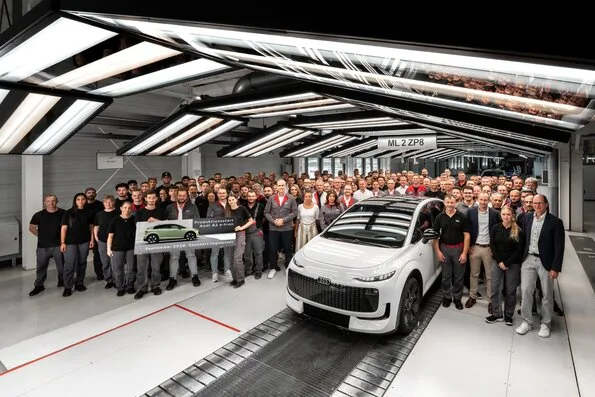
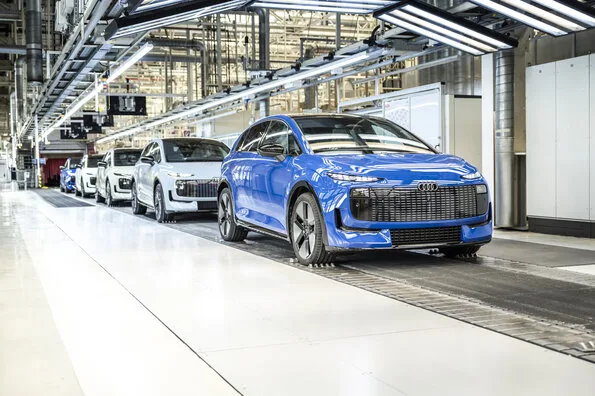
Audi has started production of the fully electric A2 e-tron at its Ingolstadt plant, with the first units rolling off the line in the presence of Bavarian Minister-President Markus Söder.
The launch reflects a broader efficiency push at Audi: development time for the A2 e-tron ran 21 months shorter than previous vehicle projects, thanks to lessons carried over from earlier launches and streamlined coordination that let the car reach maturity earlier in pre-series production.
Audi also significantly cut the model’s complexity, reducing the number of production-relevant part numbers despite maintaining strong customer benefit, which in turn shrinks the number of logistics supermarkets needed and simplifies material supply within the plant.
A New Production Approach for Ingolstadt
For the first time in Ingolstadt, Audi is applying its “string-of-pearls” production principle, already proven at the Neckarsulm plant, in which the sequence of customer orders is locked in six days before assembly and carried through every production stage.
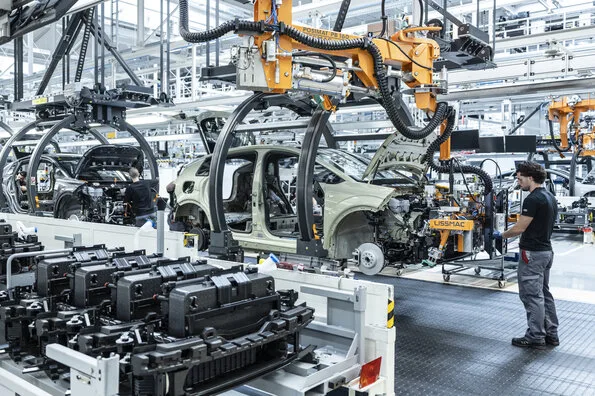
That fixed sequencing lets suppliers build parts in the correct order and pack them directly into designated containers, cutting process complexity while eliminating the need for separate storage and sequencing areas.
The plant’s flexible layout also lets Audi build A2 e-tron bodies alongside those of the A3, and more than 1,200 production components — including roughly 250 robots and robotic welding guns previously used on other Audi models — are being reused or repurposed rather than replaced.
Heavier Automation on the Line
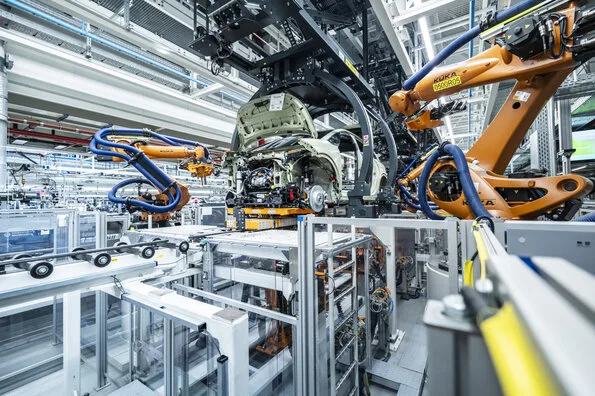
The A2 e-tron introduces fully automated wheel installation to Ingolstadt for the first time, along with fully automated robotic stations replacing the previous semi-automated bolting stations used for front and rear axle preassembly.
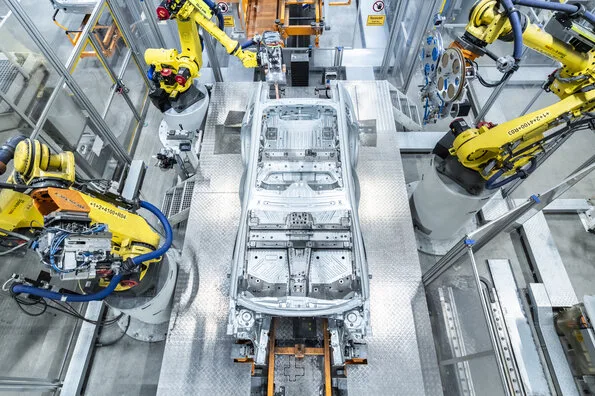
In the body shop, Audi is also deploying “bin picking” technology, which uses image processing and camera-guided robots to identify and grab components, including small sheet-metal parts pulled directly from disorganized containers for the first time — a change meant to cut down on physically demanding tasks for workers.
Cloud Systems and AI Assistants
Audi’s “Edge Cloud 4 Production” industrial cloud now centrally manages both the Universal Test System used to commission the A2 e-tron’s control units and the “operator guidance” system that provides vehicle customization information, a shift that eliminates the need for more than 450 industrial PCs on the assembly line.
Audi is also rolling out AI-powered knowledge assistants across its production sites, including a Supply Chain Chatbot that helps employees search expert knowledge and documentation, and a Maintenance Chat that supports fault analysis and troubleshooting for maintenance teams.
Investing in the Workforce
Audi paired the technical changes with early, targeted workforce training, combining hands-on assembly-line instruction with digital tools like screen-based virtual assembly training to prepare employees for building a fully electric model.
The company frames that qualification program as both strengthening electromobility expertise at Ingolstadt specifically and anchoring skills the plant will need for future technology transitions.