
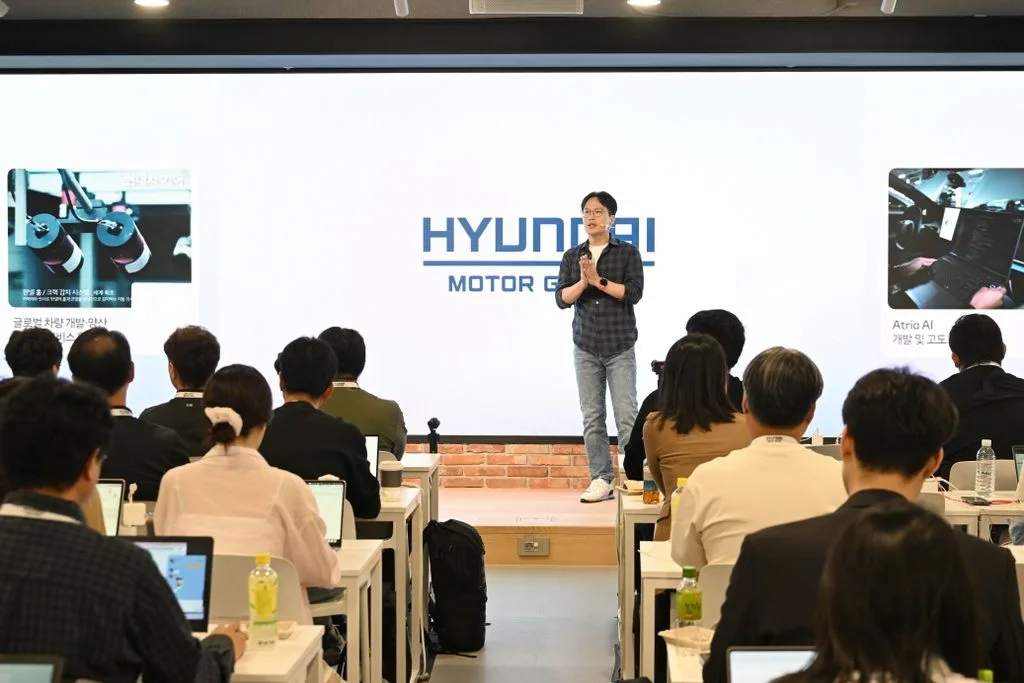
Hyundai Motor Group used its “HMG Autonomous Driving Media Day” at 42dot’s headquarters in Gyeonggi Province to lay out its roadmap for the next stage of autonomous driving development, including the first public showcase of Level 2++ capability.
Central to the announcement was confirmation that the company’s “Data Flywheel” system — a continuous loop of data collection, AI training, validation and deployment — is now fully operational. Minwoo Park, President of the Advanced Vehicle Platform Division and CEO of 42dot, framed the competitive landscape around speed and scale of learning rather than any single feature, saying Hyundai’s goal is building systems that let it learn and improve rapidly while still delivering the safety and quality customers can trust.
Two Paths to Production
Hyundai is pursuing what it calls a dual-track strategy, first announced in March through a collaboration with NVIDIA. The first track integrates NVIDIA’s vehicle AI computing platform and autonomous driving software into Hyundai’s software-defined vehicle architecture, prioritizing faster deployment; production vehicles with NVIDIA-based Level 2+ capability are targeted for the first half of 2028, with Level 2++ following in the second half of that year.
That track also includes progressively standardizing sensor systems across Hyundai Motor, Kia, 42dot and Motional around NVIDIA’s DRIVE Hyperion 10 platform, aimed at making data collection and AI training more consistent group-wide.
The second track centers on Atria AI, a proprietary end-to-end autonomous driving system jointly developed by the AVP Division and 42dot, with Atria AI-powered Level 2++ production vehicles targeted for the second half of 2029, progressing in phases based on real-world data gathered from production vehicles. Together, the two tracks are meant to deliver near-term capability to customers while building longer-term technological independence.
Scaling Data Collection and Smarter Learning
The Data Flywheel’s advantage starts with scale: Hyundai Motor and Kia sell more than 7 million vehicles annually across roughly 190 countries, and the Group currently runs about 40 dedicated data-collection vehicles around the clock, gathering not just routine driving data but real-world edge cases like construction zones, severe weather, sudden lane changes, vehicles parked on narrow streets, and complex urban traffic.
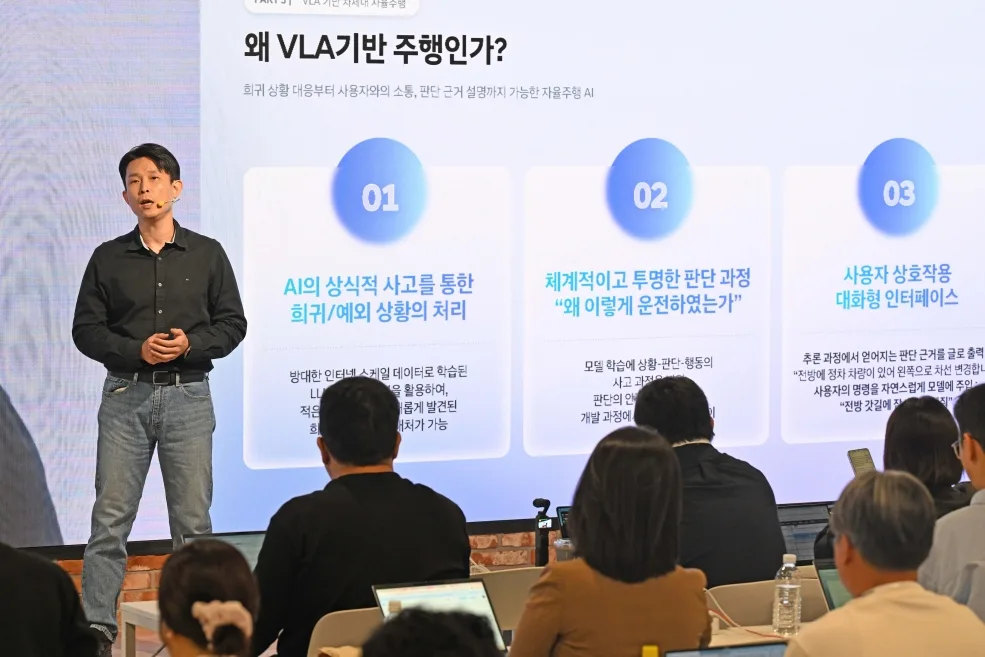
But Hyundai emphasizes that raw data volume alone doesn’t determine AI performance — several techniques introduced this year focus on learning efficiency instead. Hard Example Mining automatically flags driving situations AI models struggle to interpret and prioritizes them for training, while a Continuous Training Pipeline feeds newly collected data and validation results back into model development on an ongoing basis, shortening development cycles.
Virtual Validation Technology reconstructs real driving data into 3D environments — using tools like 3D Gaussian Splatting — to recreate scenarios too dangerous or difficult to test in the real world, letting engineers evaluate models against edge cases while confirming updates don’t degrade existing performance.
A Follow-the-Sun development model links Korea- and U.S.-based teams across time zones for effectively round-the-clock development, and the Group is gradually integrating its Special Event Recorder system, which automatically logs significant driving events for use in AI training, with further work underway to make it better at automatically identifying useful edge cases.
A broader Data Union framework, built on standardized sensor architecture and data structures, is also being established to let data generated across Hyundai Motor, Kia, 42dot and Motional accumulate under shared standards for AI training, with expansion beyond those four organizations planned for later.
Testing on Real Korean Roads
Alongside its mass-production timeline, Hyundai is pursuing real-world Level 4 validation, planning to deploy an Atria AI-equipped SDV Pace Car in Gwangju, South Korea by the end of the year in partnership with the country’s Ministry of Land, Infrastructure and Transport.
Unlike controlled test tracks, the pilot will expose the system to Korea’s actual traffic complexity and unpredictability, with scenarios encountered during deployment feeding directly back into the Data Flywheel. Junghyun Kwon, head of Hyundai’s Autonomous Driving Development Center and 42dot’s Autonomous Driving Division Lead, said competitiveness comes down to how quickly data can be connected to learning, validation and improvement rather than data volume alone, while 42dot’s Atria Group Lead Seonggyun Jeong said strong autonomous driving AI ultimately depends on high-quality data moving through that same integrated development cycle.
42dot’s Next Step: Vision-Language-Action AI
Beyond its existing end-to-end autonomous driving models, 42dot is developing Vision-Language-Action (VLA) technology, which combines visual recognition, language-based reasoning and action generation into a single framework.
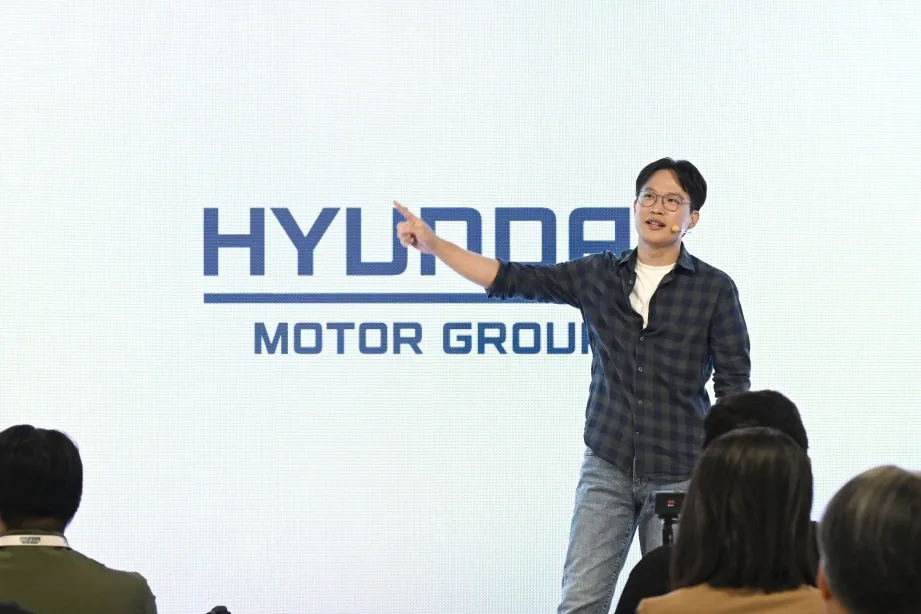
Where conventional end-to-end models connect driving inputs directly to vehicle actions, VLA adds a layer of language-based situational understanding intended to improve decision-making and explainability in complex scenarios, and 42dot expects it to help the system respond better to rare situations by drawing on large-scale pre-trained knowledge that’s hard to learn from driving data alone.
The Data Flywheel approach extends to VLA development too — when driving issues surface, the team analyzes the root cause, reinforces the relevant data and policies, and retrains the model. VLA is currently in simulation-based validation, with real-vehicle testing and full development set to run from late 2026 through early 2027.
In demonstration footage, the VLA model displayed on-screen text explaining both the action it took and the reasoning behind it. HeeSeok Lee, Group Lead of 42dot‘s Trion Group, described VLA as core to Physical AI more broadly — technology that goes beyond driving to understand, reason through and act on situations, with autonomous driving serving as the starting point before expansion into fields like robotics.
New Footage From Seoul’s Streets
Hyundai also released new footage of an Atria AI-equipped SDV Testbed navigating real Seoul traffic without driver intervention, framed around everyday urban complexity rather than controlled scenarios.
An executive ride-along video shows Minwoo Park and Seonggyun Jeong riding through central Seoul across expressways, major roads, bridges and city streets while discussing Atria AI’s development and capabilities.
Three unedited one-take clips — covering rush-hour congestion in Gangnam, high-density traffic with frequent bus interactions in Jamsil, and rainy conditions in Pangyo — show the system recognizing vehicles, pedestrians, lane markings, intersections and traffic signals while adapting to changing conditions in real time.
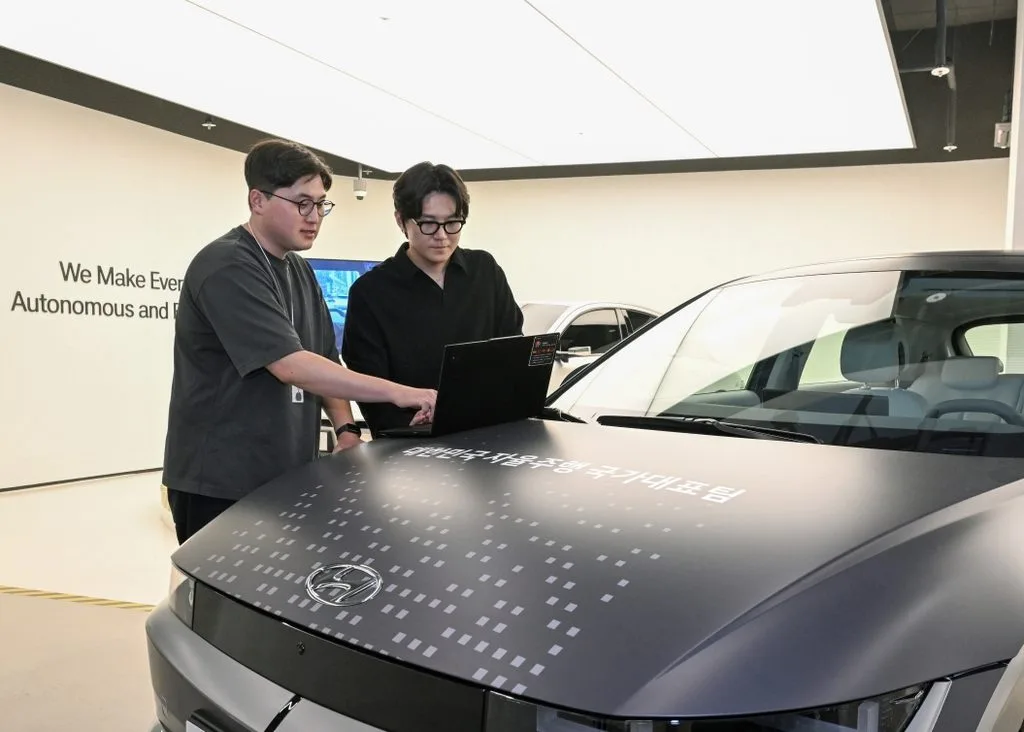
A separate edge-case video covers ten scenarios, including avoiding roadside-parked vehicles, responding to sudden cut-ins, navigating unprotected left turns, spotting pedestrians in crowded areas and identifying oncoming traffic on narrow neighborhood roads.
All of the footage is available on Hyundai Motor Group’s YouTube channel. Park closed by describing autonomous driving as the flagship application of Physical AI and central to the auto industry’s broader shift toward AI, arguing that development speed and safety aren’t in conflict — the more edge cases the system encounters and learns from, he said, the safer it becomes — while maintaining that only thoroughly validated technology will make it into production vehicles.