
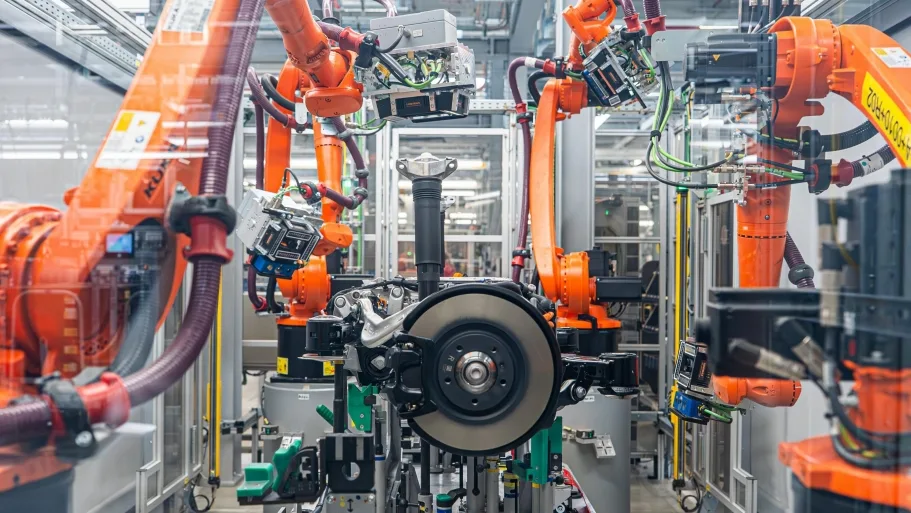
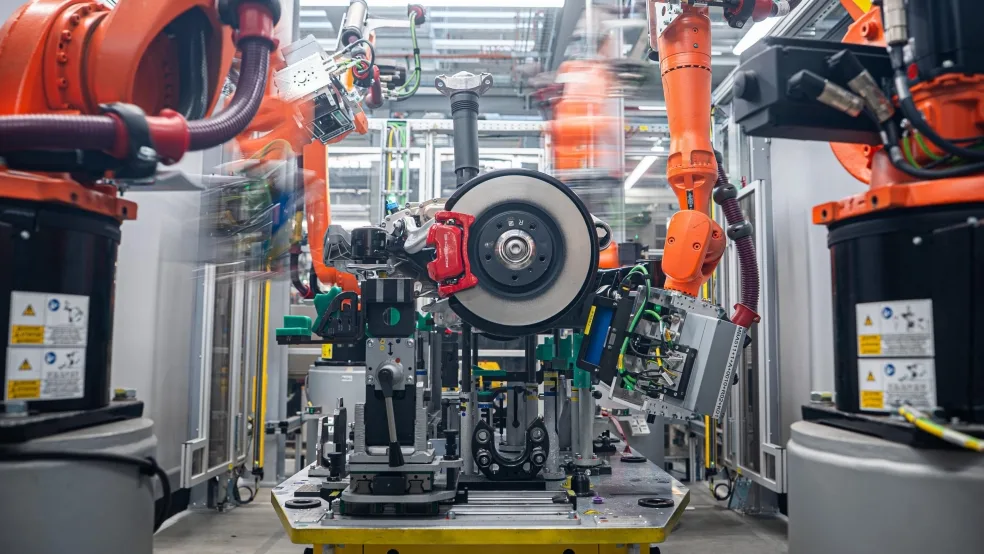
At Porsche‘s Leipzig plant, axle assembly has become a showcase for where engineering know-how meets automation. Once a freshly built axle rolls into the inspection cell, four robotic arms take over — moving with precision, pausing, scanning, and inspecting up to 130 points on a single axle in just 80 seconds.
It’s the kind of task that would exhaust a human’s concentration fast. For the robots, equipped with cameras and sensors capable of catching even the smallest deviations, it’s simply routine — and those deviations matter, since they can directly affect how the car drives.
Why the Axle Gets Special Treatment
The axle ranks among a vehicle’s most complex components: safety-critical, built in numerous variants, and central to both driving dynamics and comfort. That’s why Porsche Leipzig runs an automated end-of-line inspection (AEOL) system that pairs human expertise with robot-assisted precision.
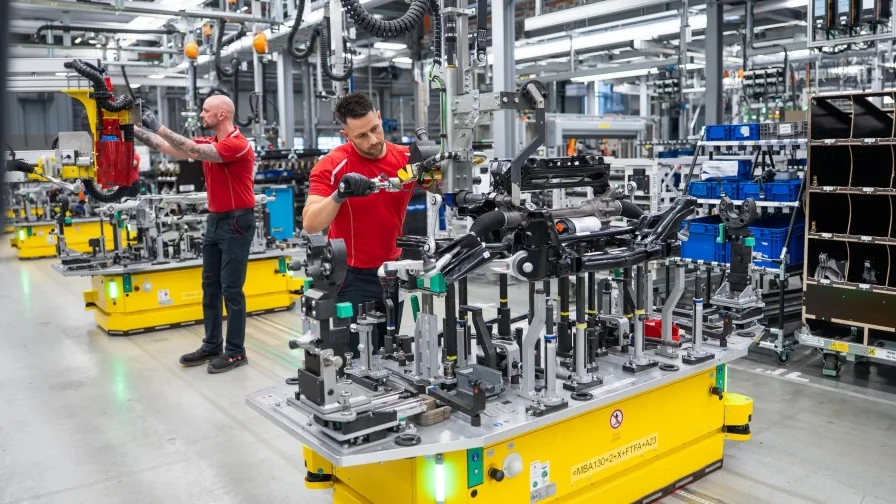
“The system scans the entire axle, stops at each inspection point and takes a photo. The image is analysed immediately,” says Thomas Fredrich, inspection planner in quality management. The process identifies connectors, measures distances, and checks correct installation against stored contours — with all image data kept for up to three years, so any axle can be traced back to its exact condition at the moment it was built.
Where Human Judgment Still Wins
Even so, the AEOL system isn’t meant to work alone — it’s one layer of a broader, multi-stage quality process. Robots handle the repetitive, hyper-focused inspection work, freeing shopfloor employees to focus on the things that still require experience and human judgment.
Not everything shows up on camera. “Grinding noises from brake discs, for example, cannot be checked by the system — you can’t see noise,” Fredrich notes. A manual final inspection still follows the automated pass, with human and machine effectively covering each other’s blind spots.
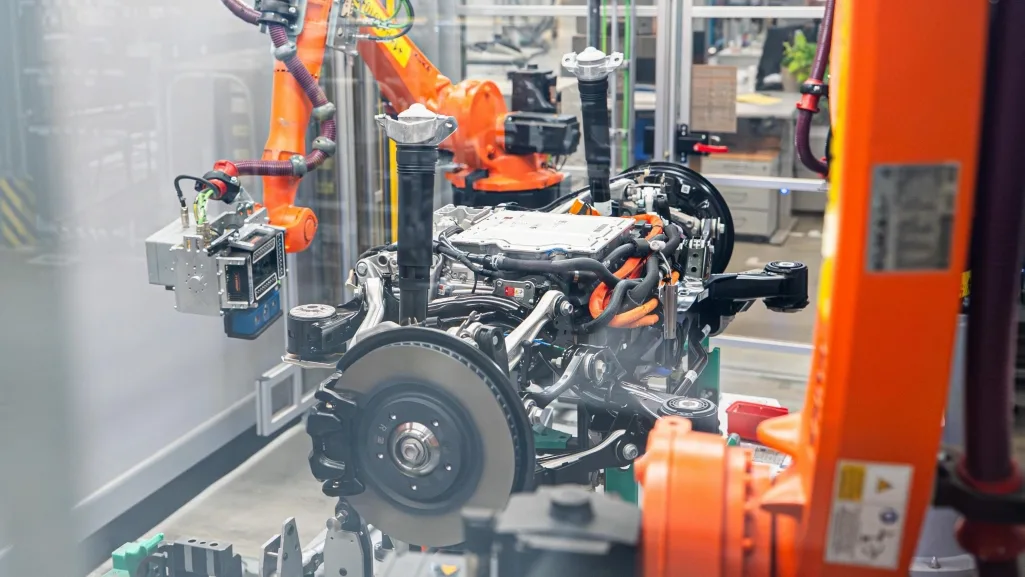
Getting the system to this point took extensive validation during ongoing series production. Engineers had to deliberately introduce faults at each inspection point to confirm the system would catch them reliably, while also working to cut down false positives. “If the image processing flags an error that isn’t one, we analyse it and fine-tune the system,” Fredrich explains.
Porsche Leipzig, A Plant With a Track Record
The axle-inspection project is just one piece of a broader lean-production push at Porsche’s Saxony site — one that’s recently earned outside recognition. Leipzig took the OEM category win at the Automotive Lean Production Award, impressing judges with its automation solutions and digital intelligence.
Porsche Leipzig opened in 2002 as the company’s second production site alongside its Stuttgart-Zuffenhausen headquarters, and today builds the Macan and Panamera lines.
The Cayenne was assembled there until 2017, and the Carrera GT super sports car rolled off the same line between 2003 and 2006. The plant has picked up several other honors for its smart, sustainable production approach, including the Lean and Green Management Award in 2021 and the Factory of the Year title in 2023.