
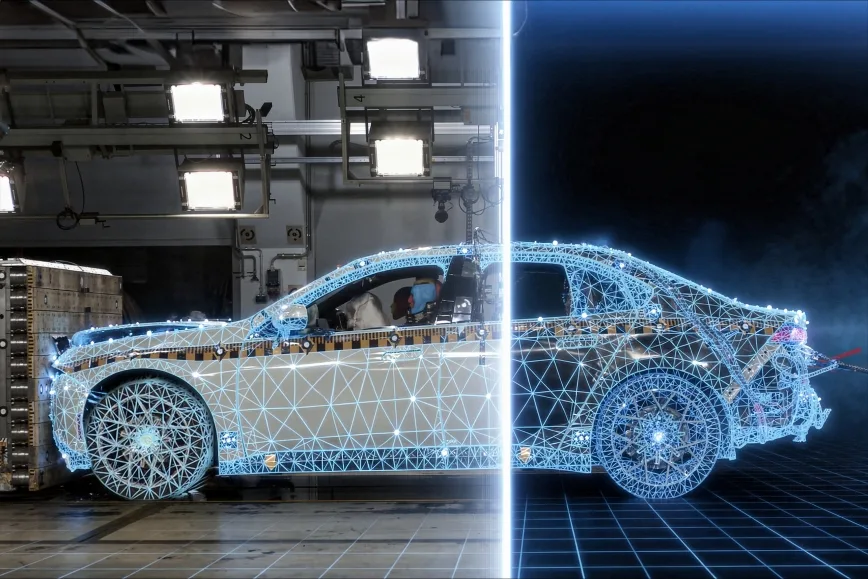
The BMW Group and Mistral AI are joining forces to advance the use of AI in crash simulation, with the goal of improving quality, accuracy, and speed across complex engineering tasks.
The collaboration represents a first step toward scaling domain-specific AI into further areas of vehicle development and the wider BMW Group value chain.
Dr. Franz Decker, CIO and Senior Vice President of the BMW Group, stated that for the company, the use of industrial data is a key factor in turning artificial intelligence into value creation. By pairing BMW’s engineering datasets with Mistral AI’s model training capabilities, they are constructing specialized AI that supports complex development tasks.
Scale of Crash Simulation Data
The scope and complexity of crash simulation at the BMW Group reinforce the case for domain-specific AI. Each week, the company conducts thousands of virtual crash simulations, generating enormous volumes of engineering data.
Over time, this activity has produced a historical dataset exceeding one petabyte of crash simulation data. That archive delivers highly detailed insights into vehicle structures and material behaviour, forming a unique basis for training an industrial AI model.
Marjorie Janiewicz, Chief Revenue Officer of Mistral AI, stated that as Industrial AI becomes the new frontier for AI, the company is proud to partner with the BMW Group. She noted the collaboration demonstrates how industry-specific AI models can help solve complex engineering challenges such as crash simulation.
Large Industry Models as the Foundation
To scale this approach, the BMW Group is concentrating on so-called Large Industry Models (LIM). These are AI systems trained on industry-specific engineering and simulation data drawn from vehicle development and safety testing.
Unlike general-purpose AI systems, LIMs embed domain-specific knowledge directly into the model. Achieving this requires not only industrial data but also deep domain expertise and technical environments that enable AI systems to learn directly from BMW’s development processes.
The partnership underscores the importance of industrial data for the next phase of data-driven value creation while strengthening the BMW Group’s AI and innovation ecosystem.