
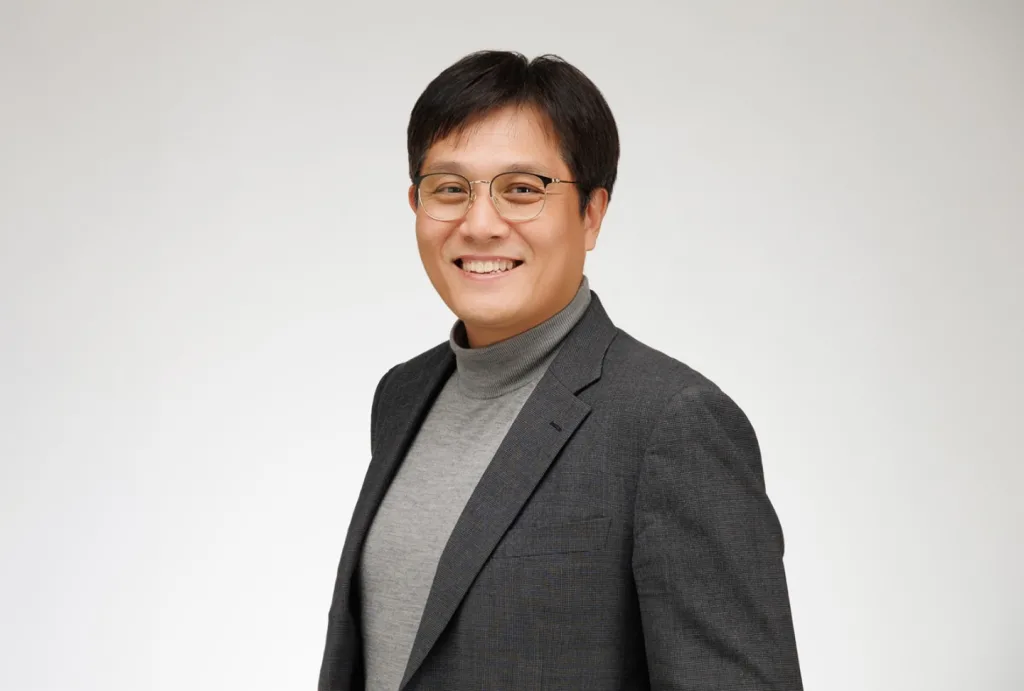
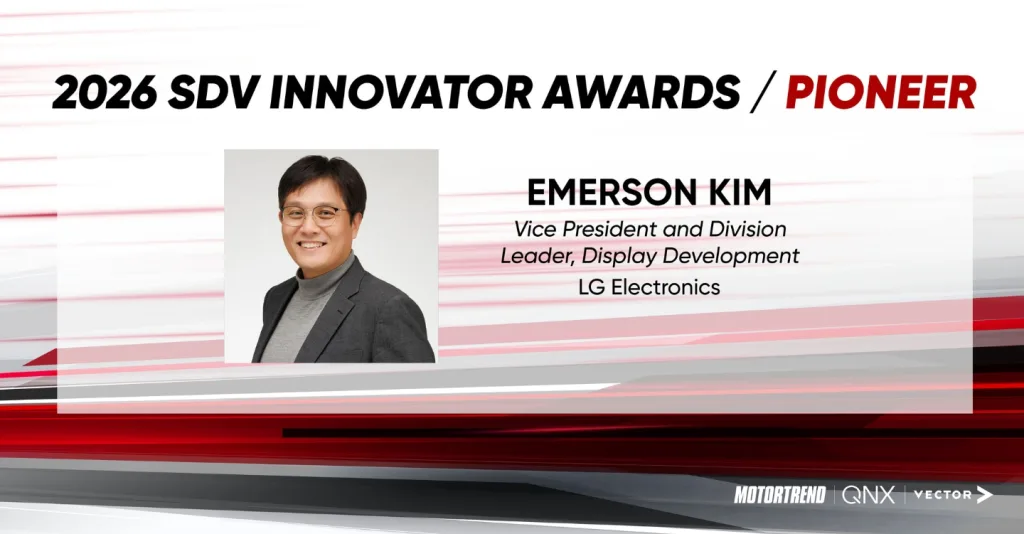
LG Electronics has been honored with the 2026 MotorTrend SDV Innovator Award in the Pioneer category, receiving recognition for developing human-centered display technologies that address fundamental interaction challenges in software-defined vehicles.
The award acknowledges LG’s ability to translate complex concepts into practical, production-ready solutions deployable at automotive manufacturing scale, reflecting industry validation of the company’s strategic approach to vehicle display innovation.
The recognition comes as software-defined vehicles transform mobility industry dynamics by shifting capabilities from fixed hardware to continuously evolving software architectures.
This transformation fundamentally changes the driving experience, enabling vehicles to grow, adapt, and improve over time through software updates rather than remaining static at production.
However, this shift raises critical questions regarding how to ensure automotive intelligence feels natural and trustworthy for drivers navigating increasingly complex vehicle systems.
Shy Tech Philosophy Emphasizes Reserved Technology Presence
LG’s approach to human-centered displays is guided by proprietary philosophy called Shy Tech, emphasizing that technology should not demand attention by default but instead maintain physically and visually reserved presence.
The fundamental principle holds that technology should make itself known only when it adds clear and meaningful value to the driving experience, stepping back during situations where its presence could create distraction or cognitive burden.
The Shy Tech concept addresses inherent tension in software-defined vehicles where technical capability enables virtually unlimited digital functionality within vehicle interiors. LG explicitly challenges the assumption that more information automatically translates to better user experiences, noting that constantly visible screens can increase distraction and driver fatigue rather than providing clarity or enhancing safety.
The context-aware approach implemented through Shy Tech minimizes visual noise by displaying information only when contextually appropriate, creating calmer interior environments that reduce driver cognitive load.
This reduction in unnecessary information presentation reinforces driver focus on primary driving tasks while maintaining safety margins that might otherwise be compromised through attention fragmentation across multiple information sources.
Shy Tech transcends mere styling considerations to represent system-level approach integrating display hardware, mechanical design, and intelligent software into cohesive interaction framework.
LG emphasizes that the philosophy defines how technology behaves – determining when displays appear, how they move physically, and when they retreat from visibility – rather than merely addressing aesthetic appearance or visual design elements.
Dual Mode Glass OLED Pop-Up Display Enables Physical and Functional Transformation
One of the clearest expressions of Shy Tech philosophy manifests in LG’s Dual Mode 24.6-inch Glass OLED Pop-Up Display, characterized as groundbreaking automotive display featuring software-controlled dual UX/UI capabilities enabling fundamental transformation of both physical presence and functional role.
The display represents significant engineering achievement in automotive human-machine interface design by integrating mechanical actuation with advanced OLED display technology and intelligent software control.
The display transitions between two distinct operational modes, changing both its physical configuration and functional purpose to match driving context and user needs.
When expanded into its full configuration, the display functions as immersive content platform optimized for streaming services and rich media experiences, providing entertainment capabilities comparable to consumer electronics devices during appropriate situations such as vehicle parking or autonomous driving modes.
When retracted into compact configuration, the same display transforms into driver-centric instrument cluster presenting clear, focused view of essential driving information including vehicle speed, navigation guidance, and Advanced Driver Assistance Systems data requiring immediate driver awareness.
This dual functionality eliminates traditional separation between infotainment displays and instrument clusters by enabling single hardware platform to serve both purposes through software-controlled mode transitions.
Crucially, the solution operates through entirely software-driven control mechanisms, enabling seamless transitions between immersive infotainment experiences and driver-focused information presentation without requiring manual user intervention or mechanical mode selection.
This software-centric architecture proves that driver engagement and safety do not represent inherently competing priorities – when intelligently orchestrated through appropriate software logic, they can coexist without compromising driver attention allocation to safety-critical tasks.
The Glass OLED technology employed in the display provides superior image quality characteristics including perfect black levels, infinite contrast ratios, and wide viewing angles that prove essential for automotive applications requiring readability across diverse ambient lighting conditions.
The pop-up mechanical mechanism enables physical transformation that changes the display’s spatial relationship to the driver, optimizing viewing geometry for different functional modes while enabling the display to retract when not needed.
Bendable Moving Display Technology Provides Continuous Contextual Adaptation
LG applies similar Shy Tech principles to its Bendable Moving Display technology, which extends beyond simple binary on-off states to provide continuous adaptation matching evolving driving situations.
Rather than merely appearing or disappearing, the bendable display adjusts its physical configuration and information presentation in graduated fashion responding to contextual factors including driving mode, route characteristics, and user preferences.
When information presentation or entertainment consumption is contextually appropriate – such as during highway cruising with active driver assistance, vehicle parking, or autonomous driving operation – the display emerges into prominent position with expanded information presentation.
Conversely, when driving situations demand maximum driver focus on primary driving tasks, such as navigating complex urban environments or adverse weather conditions, the display retreats to minimize potential distraction.
These physical movements and information presentation transitions are orchestrated through intelligent software analyzing multiple data sources including vehicle operating conditions, driver behavior patterns, and environmental factors.
The software-driven orchestration enables personalized adaptation based on individual driver preferences, fluid motion profiles that avoid jarring transitions, and over-the-air update capability allowing the system to evolve and improve throughout vehicle lifecycle.
Within this architectural framework, software transcends traditional role as mere control layer to become the architect of interaction, fundamentally shaping what information is displayed, when technology actively engages with drivers, and when it deliberately steps back to reduce cognitive load.
This software-centric approach aligns with core software-defined vehicle principles emphasizing inherent flexibility and continuous improvement through software updates rather than fixed functionality determined at manufacturing.
Platform-Based Mindset Leverages Cross-Industry Experience
LG’s display innovations for software-defined vehicles are grounded in platform-based development mindset cultivated across diverse product categories including mobile devices, consumer electronics, and automotive systems.
This cross-industry experience provides unique perspective on display technology development, user interface design, and software integration that purely automotive suppliers may lack.
The platform approach emphasizes designing solutions with inherent scalability enabling deployment across multiple vehicle programs and price points, software readiness ensuring displays can fully leverage evolving software capabilities, and intuitive interaction principles derived from consumer electronics experience where user experience quality directly influences commercial success.
In the software-defined vehicle era, this platform mindset allows LG’s display solutions to grow organically with vehicles throughout their operational lifecycles.
Rather than being locked into fixed functions determined at manufacturing, displays become integral components of larger interaction frameworks that can be continuously refined over time as software capabilities expand, new services become available, and user needs evolve based on changing mobility patterns.
The scalability inherent in platform-based design enables LG to address diverse automotive market segments from entry-level vehicles requiring cost-effective solutions to premium and luxury segments demanding cutting-edge technology and maximum flexibility.
This broad market coverage proves essential for achieving manufacturing volumes that justify substantial research and development investments in advanced display technologies.
Future Success Measured by Experience Quality Rather Than Technology Quantity
LG articulates vision that the future of software-defined mobility will not be measured by how much technology vehicles contain but rather by how intelligently they deliver experiences enhancing driver and passenger satisfaction.
This experience-centric perspective represents important philosophical shift from technology-first mindsets that prioritize feature accumulation over thoughtful integration and user-centered design.
Displays will play central roles in translating abstract software capabilities into tangible clarity that enables informed decision-making, confidence that builds trust in vehicle systems, and emotional connection that creates positive associations with the driving experience.
LG positions its goal as building display technologies that empower users without overwhelming them through excessive information or unnecessary complexity, adapt to changing contexts without creating distraction, and evolve through software updates without losing sight of fundamental human needs and capabilities.
As software-defined vehicles continue reshaping mobility industry structures and competitive dynamics, LG commits to ongoing innovation ensuring that technology serves people’s needs quietly through unobtrusive operation, seamlessly through natural integration into driving workflows, and intuitively through interfaces requiring minimal learning investment.
Strategic Implications for Automotive Display Market
The 2026 MotorTrend SDV Innovator Award recognition positions LG Electronics as thought leader in automotive display technology evolution, providing credibility with automotive manufacturers evaluating display suppliers for next-generation vehicle programs.
The Pioneer category designation specifically acknowledges LG’s role in defining new technological approaches rather than merely optimizing existing solutions.
LG’s Shy Tech philosophy and associated display technologies address fundamental challenges in software-defined vehicle development where traditional approaches to human-machine interface design prove inadequate for managing substantially increased information complexity and functional capability.
By articulating clear design principles and demonstrating production-ready implementations, LG provides automotive manufacturers with frameworks for addressing these challenges systematically rather than through ad-hoc solutions.
The emphasis on software-driven functionality aligns with automotive industry’s broader shift toward software-defined architectures where hardware platforms provide flexible foundations enabling differentiation and continuous improvement through software rather than requiring hardware changes for feature enhancements.
LG’s display solutions designed specifically for software-centric architectures position the company advantageously as automotive manufacturers increasingly prioritize suppliers capable of supporting software-defined vehicle strategies.
The integration of mechanical actuation with advanced display technology and intelligent software control represents substantial engineering achievement requiring expertise spanning multiple disciplines.
LG‘s demonstrated capability to develop and manufacture such complex integrated solutions at automotive quality and volume requirements provides competitive differentiation against suppliers with narrower technical capabilities or limited automotive manufacturing experience.