
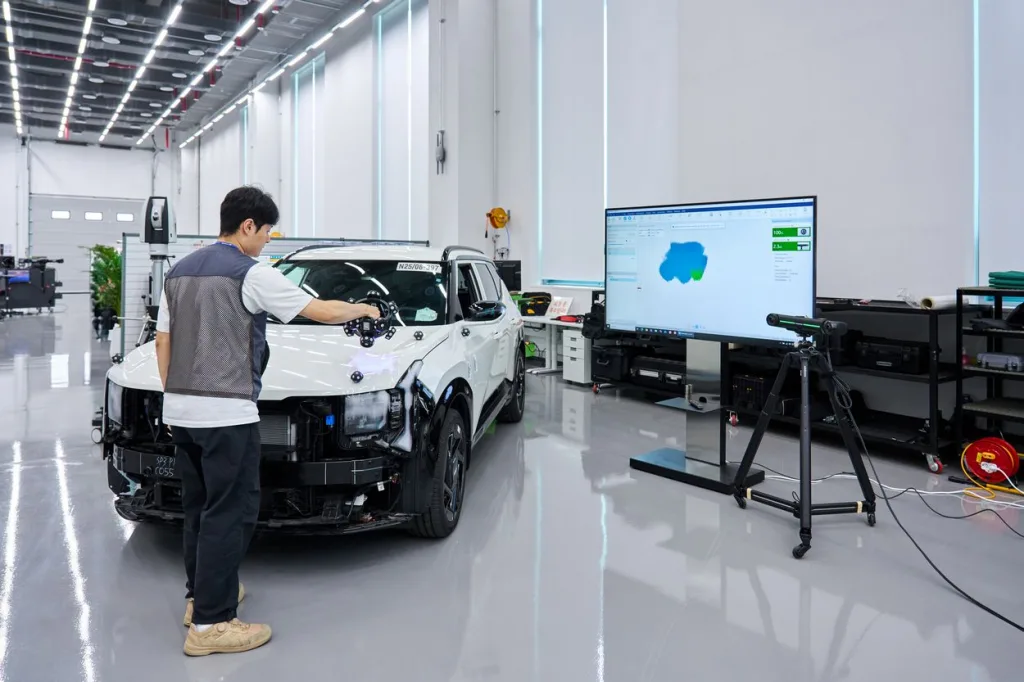
Small, easy-to-miss issues — a door that doesn’t latch quite right, a gap that lets water in, faint wind noise on the highway — rarely trace back to major structural failures. More often, they come down to dimensional precision: how accurately a vehicle’s parts actually fit together.
Hyundai Motor and Kia built the Digital Measuring Center (DMC) at their Namyang R&D Center in South Korea to catch those issues before they reach customers, using Coordinate Measuring Machines (CMM) to check up to 1,000 points on a single vehicle body against roughly 600 quality criteria.
The center tracks four areas — exterior quality, noise/vibration/harshness (NVH), water tightness, and function and assembly feasibility — targeting variances too subtle for a visual inspection to catch.
Starting at the Body Structure
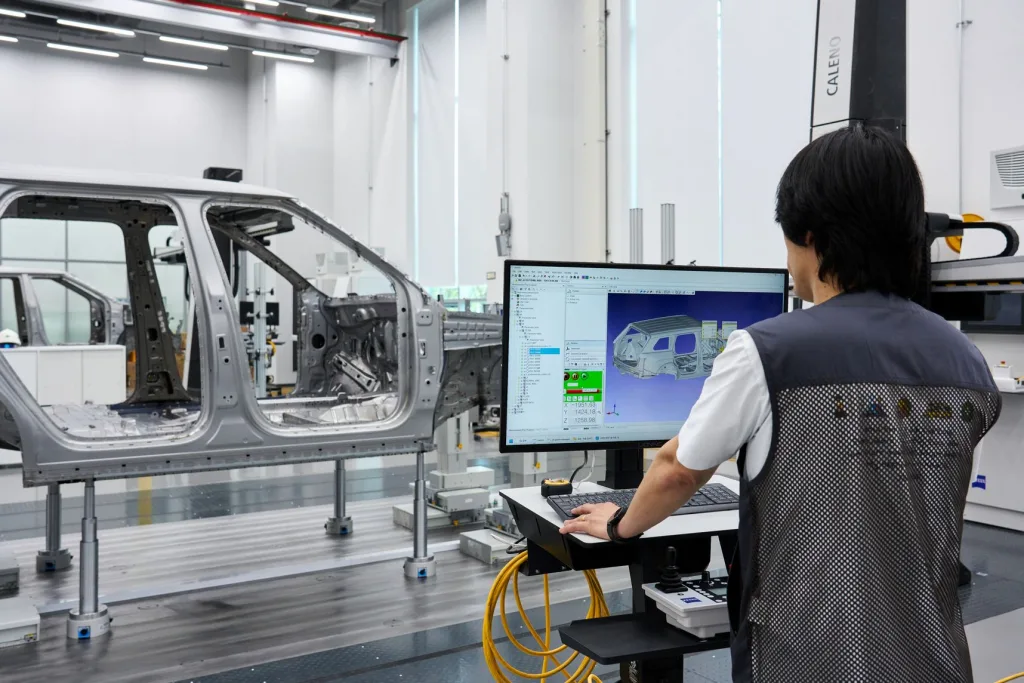
Measurement begins with the vehicle’s body itself. CMM systems fitted with precision contact sensors scan roughly 1,000 points per vehicle, capturing 3D coordinates engineers then use to calculate deviation, distance and parallelism across hundreds of quality benchmarks — standards that get passed directly to manufacturing plants so production vehicles match.
Jaemin Ha, Part Leader of the Pilot Quality Verification Team, said the DMC’s goal is to raise the entire Hyundai Motor Group’s measurement capabilities by combining measurement, analysis and data management in one system, ultimately sharpening the driving quality, quietness and durability customers actually feel.
From Moving Parts to Full Assembly
Doors, liftgates and other movable components get their own process: optical 3D scanners mounted on robotic arms handle full-geometry measurements, while autonomous mobile robots ferry parts between stations with minimal need for a human operator.
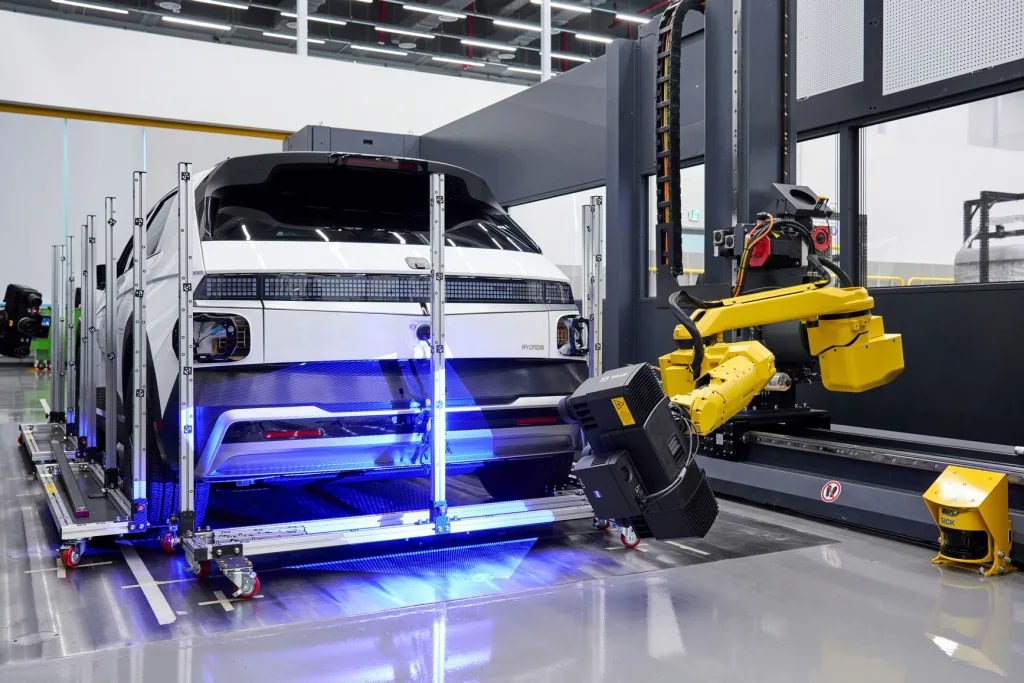
Before final assembly, components are mounted on fixtures that mimic actual body geometry so engineers can use portable 3D scanners to check assembly quality early, catching problems before they compound. Software builds a virtual measurement environment from reference markers automatically, keeping the manual scanning process fast without losing accuracy.
A separate final-validation stage scans the completed vehicle and analyzes how dimensional variation has accumulated across the body, components and trim — the kind of layered deviation that’s nearly impossible to spot by eye, but traceable back to its source thanks to data kept from every development stage.
Testing Parts in Motion
A dedicated dynamic motion validation lab pushes doors, liftgates and other movable parts through real-world use, with ultra-high-speed cameras and sensors capturing deformation data at 500 measurements per second as components open and close — fast enough to reveal movement the human eye simply can’t register.
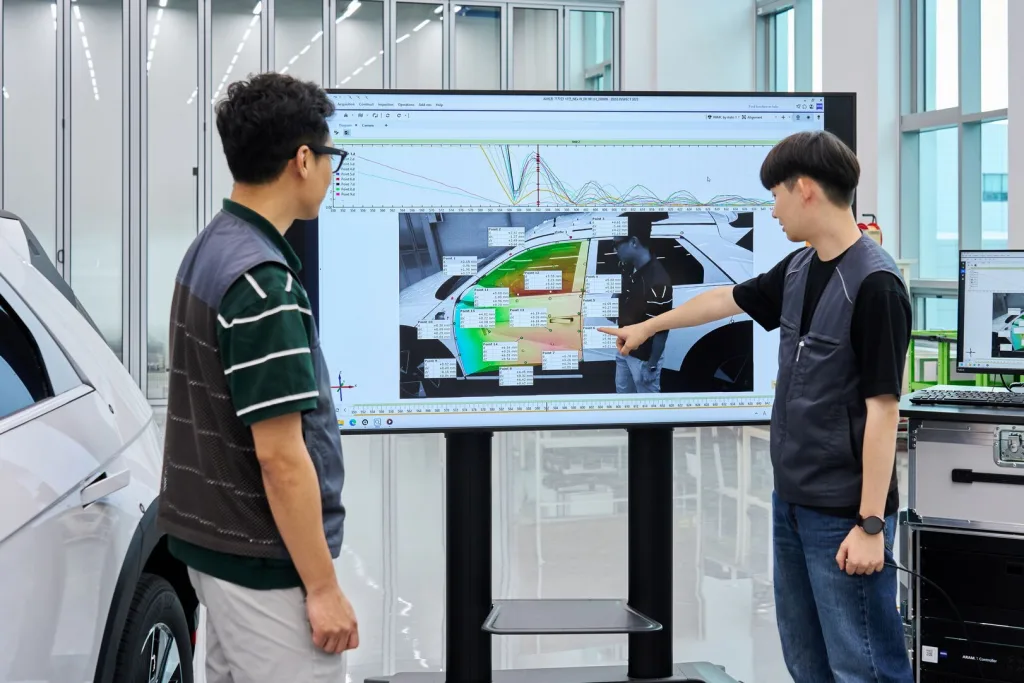
The lab also studies how added component weight and residual deformation from outside loads affect long-term durability.
Turning Measurements Into Fixes
All of this data funnels into a centralized data center that pulls together measurements from every development stage, system and supplier, giving engineers a faster path to root causes and better cross-functional collaboration.
Two algorithms sit at the center of that analysis: DATA-FIT, which uses measurement data to find optimal assembly configurations in a virtual environment, and DATA-AUDIT, which flags likely sources of dimensional variation and quality risk.
Hyundai Motor Group also plans to use the accumulated measurement data to build out AI-based infrastructure for future vehicle development. As Ha put it, the goal is for painstaking attention to both visible and hidden quality to translate into a sense of stability and satisfaction customers feel without necessarily being able to name why.