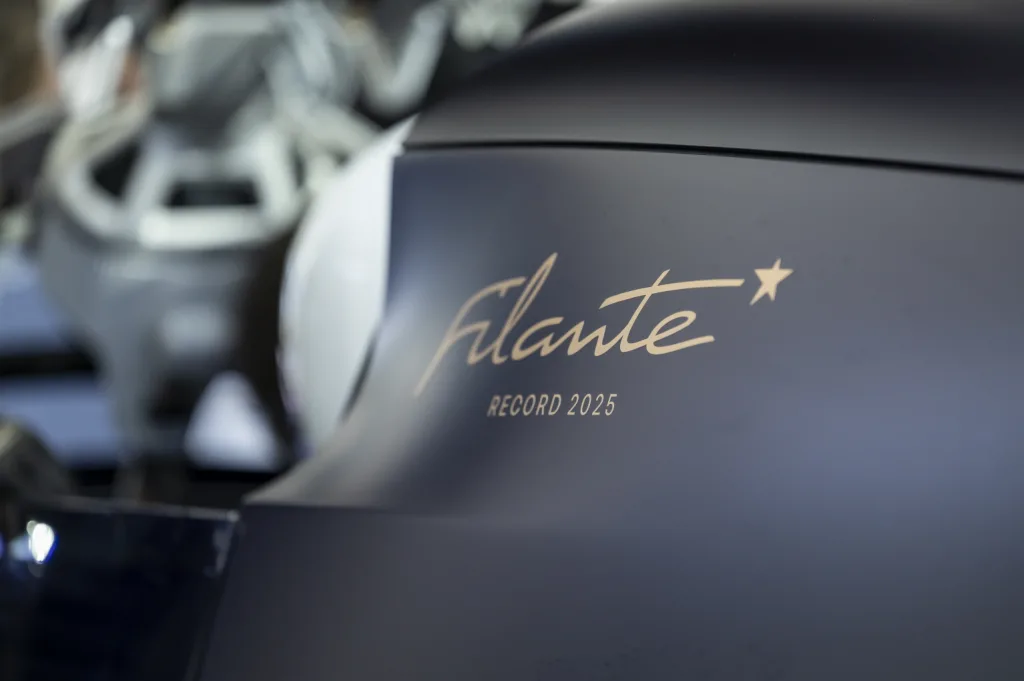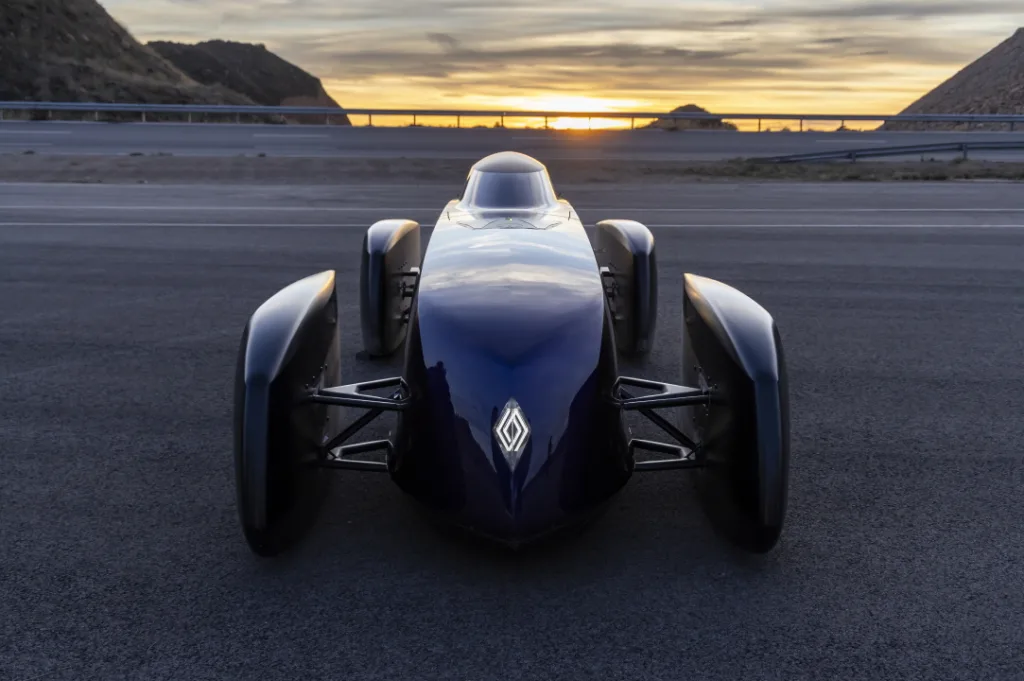
Father Christmas must have seen that the team had been good this year, and rewarded their hard work and innovative drive – and Renault’s – with a gift that didn’t quite fit under the tree: an electric-efficiency record for the Filante Record 2025 demo car.
A record based on real-world at an average speed of over 100 km/h
One challenge that Renault set itself at the beginning of 2025 was to drive an electric vehicle more than 1,000 km, with a battery the same size as Scenic’s, at realistic motorway speeds, without stopping to charge. The first attempt was scheduled in October but was called off at the last minute due to bad weather. The team finally pulled it off on 18 December at the UTAC test track in Morocco.
If their only goal had been to drive the longest possible distance between charges, the designers and experts could have fitted the car with a huge battery or driven it in eco mode at 30 km/h on average. But Renault was aiming much higher with its efficiency record: it powered Filante Record 2025 Record with a regular battery (87 kWh, like the one in Scenic E-Tech electric) and tasked the drivers with keeping its average speed of over 110 km/h. The objective: to cover more than 1,000 km in less than 10 hours, including technical stops and driver changes.

Rising to this challenge entailed pushing every efficiency lever as far as it would go – maximising aerodynamics, minimising weight and optimising materials.
Mini-series: the story behind the efficiency record
| An exclusive mini-series behind the scenes Renault will be running a three-episode mini-series documenting the project, with a full immersion in the Filante Record 2025 story and its journey to setting the new electric-efficiency record. Episode 1 – The beginnings: a look back at Renault’s past records and the birth of a concept car engineered as a lab for innovation. Episode 2 – Under pressure: the extreme lightweighting, technical obstacles and how Renault overcame them to reach its performance target. Episode 3 – Now or never!: the inside track on the official attempt in Morocco, crowning months of relentless work under pressure.The mini-series sheds light on the stakes, aims and excellence behind Filante Record 2025’s efficiency record. |
An aircraft-inspired tribute to Renault’s heritage
The car designed to break the record had to be purpose-engineered as well as iconic. The designers combined striking looks with Renault’s lineage, drawing inspiration from the brand’s models that have set records for efficiency, speed and endurance to create a car that bridges yesterday and tomorrow.
With its unique ultraviolet blue colour, the Filante Record 2025 pays tribute, 100 years later, to the record-breaking 40 CV of 1925. It also gives a nod to the Étoile Filante.
Beneath its all-new ultraviolet-blue finish, Filante Record 2025 pays homage, 100 years later, to the record-breaking 40 CV of 1925. It also gives a nod to the Étoile Filante of 1956, while weaving in hallmarks from the world of aviation. The protective bubble over the cockpit hints at a fighter jet and the driver’s position is modelled after Formula 1 single-seaters.
The single principle that guided Filante Record 2025’s design and development was to maximise efficiency and minimise electricity consumption.
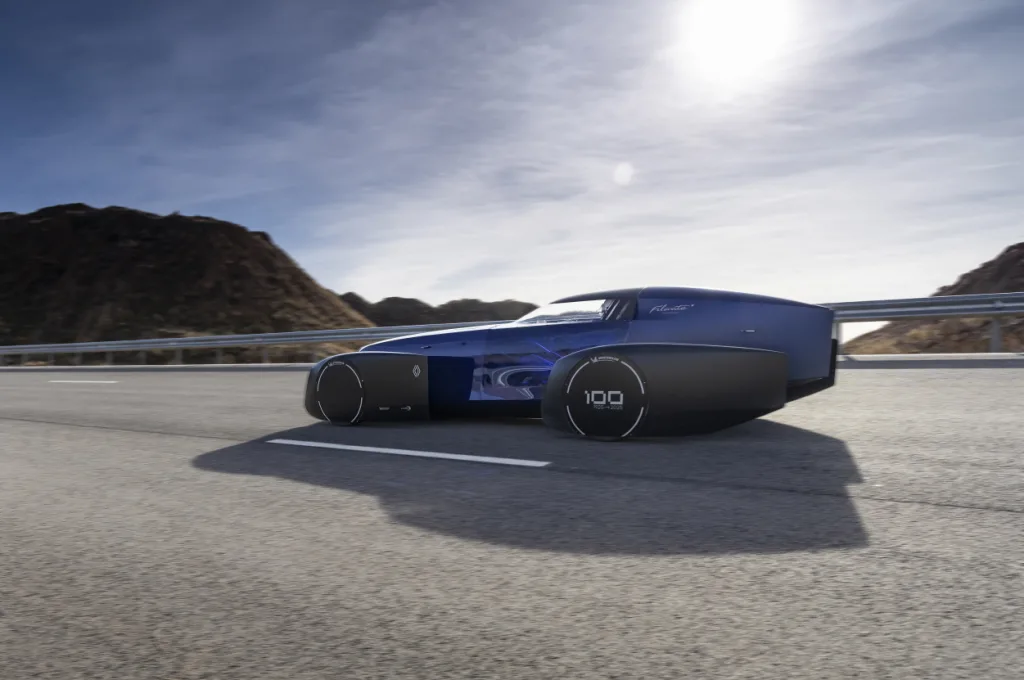
“The overarching goal, from the first sketches to the final test-track drive, was absolute efficiency. That’s the hallmark of a record-breaking car – and it mirrors Renault’s pioneering spirit and tradition since its inception in 1898. A lot like the 1925 40 CV and the 1956 Étoile Filante, Filante Record 2025 was engineered to become the first road-worthy car to drive 1,000 km at over 100 km/h without recharging, with an 87 kWh battery exactly like the one powering Scenic E-Tech electric. This accomplishment took a lot of exacting work on several fronts – ultra-efficient aerodynamics of course, the low-rolling-resistance tyres, the lightweight materials (including carbon fibre and 3D-printed aluminium components) and advanced technical features (steer-by-wire for instance). Teams of experts from Renault and its partners Michelin and Ligier worked on every aspect of Filante Record 2025’s design to demonstrate that electric vehicles can now travel long distances without recharging, even at sustained speeds.”
Sandeep Bhambra – Chief Designer Advanced Renault
Forward-looking design for next-level efficiency
The first Filante Record 2025 version, unveiled at the Rétromobile trade show last winter, already had a silhouette intertwining aircraft-like lines and cues from Renault’s heritage models. The wind-tunnel tests last spring, however, revealed significant potential for optimisation.
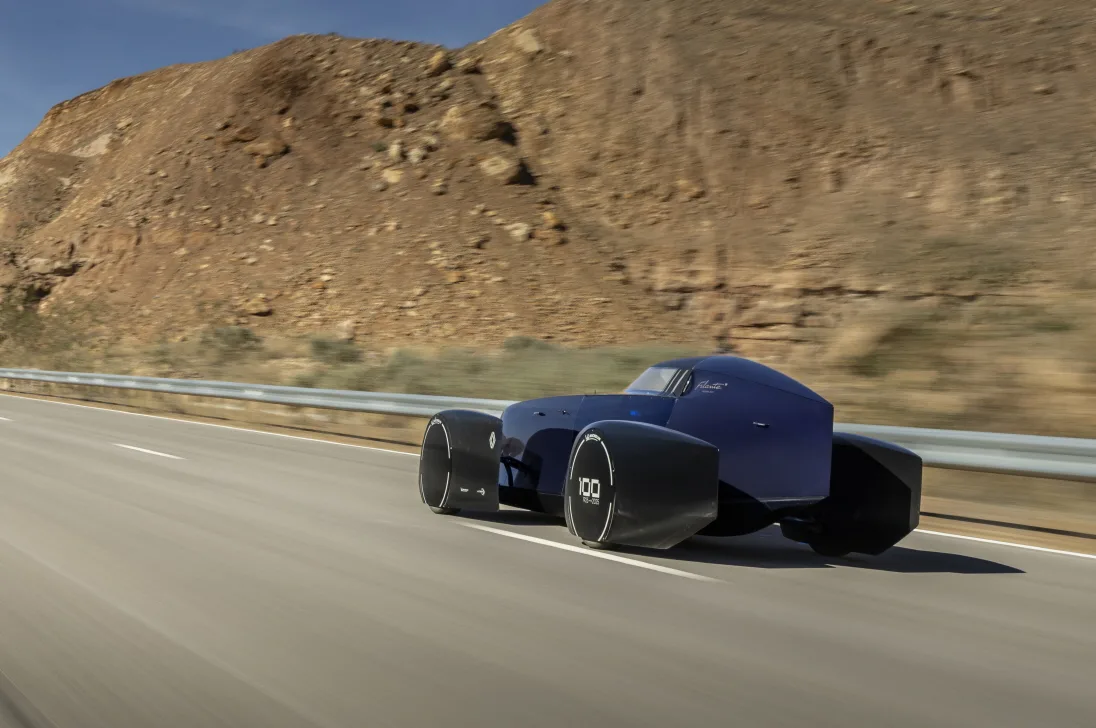
The teams therefore got back to work – as always with the aim of setting the next record for efficiency. They reshaped the fairings, which they had initially designed to resemble the ones on the Étoile Filante, and mounted them directly onto the wheels. Besides making the silhouette look airier, this alteration considerably improved the car’s airflow.
The central structure was already close to ideal from an aerodynamic perspective, so it remained practically unchanged. Most of the adjustments involved optimising technical interface areas and reducing air intakes to limit any residual drag.
An array of leading-edge technology
Renault Filante Record 2025 is a lab on wheels showcasing several innovative features for the first time:
- All-electronic steering and braking systems (steer-by-wire and brake-by-wire), which open up more architectural possibilities while reducing weight.
- Extensive use of ultra-light materials (carbon fibre, aluminium alloys, 3D-printed Scalmalloy).
- Optimal component shapes and patterns (to only use materials where required).
- Custom-engineered Michelin tyres offering low rolling resistance and enhancing aerodynamics.
Teamwork in action
The people on this project were every bit as vital as the groundbreaking technology. Breaking this new record took more than setting a target and reaching it: it was a full-scale challenge that engineers, designers, partners and three Renault Group drivers (Constance Léraud-Reyser, Laurent Hurgon and Arthur Ferriere) tackled together. It showcases Renault’s expertise as well as its close collaboration with partners including Ligier, which developed the powertrain and chassis, and carbone structure, and Michelin, which engineered the low-rolling-resistance tyres specifically for Renault Filante Record 2025.
The human adventure and pressure behind the efficiency record
18 December 2025, UTAC test track, Morocco.
Last October in France, an initial record attempt was cancelled three days before the target date due to poor weather conditions. The teams rallied together to give Filante Record 2025 every chance of setting a new efficiency record before the end of the year. Now it’s time to head to Morocco. The development teams, engineers, partners, drivers, the UTAC circuit team… Everyone is on high alert.
After a few tests session the day before, 18 December, the first technical teams are busy working on the concept car from 6.30am. It is 4 degrees, the weather is dry and there is no wind. The conditions and forecast are favourable: sunshine all day and temperatures reaching 13°C in the early afternoon. On the agenda: 10 hours of driving and 239 laps of a circuit just over 4 kilometers long.
Three drivers will take turns at the wheel of the demo car, in shifts of around two or three hours. At 7:50 a.m., Laurent Hurgon puts on his helmet, then his gloves. He gets into the car and the cockpit closes. The departure is scheduled for 8 a.m., as soon as the first light of day appears. It’s time for a real endurance test. Contact, first turns of the wheels, Filante Record 2025 speeds towards its destiny.
After 3 hours and 20 minutes, the first handover to Constance Léraud-Reyser. Following a 4-hour stint, Arthur Ferriere takes over to bring the challenge to a close at nightfall.
9 hours and 52 minutes later (excluding the 7 minutes driver change), the goal is achieved: 1,008 kilometres have been covered at an average speed of 102 km/h, without any recharging, representing consumption of just 7,8 kWh/100 km.
With 11% battery capacity remaining at the finish, Filante Record 2025 could have covered an additional 120 km at speeds exceeding 100 km/h.

A vision to shape the future, and the innovation to power it
Renault Filante Record 2025’s stylistic explorations, groundbreaking technology and proven real-world performance add up to far more than a simple engineering exercise: the findings from this venture will inform the development of future road-going electric models, enabling them to achieve ever higher levels of efficiency and meet customers’ real-life needs ever more closely – even in the most demanding conditions, such as sustained highway speeds.
| How design enhances efficiency “The wind-tunnel tests last spring showed us exactly what our computer simulations had hinted at: that Filante’s drag coefficient was too high. It was close to 0.40 and we had to bring it down to about 0.30. We realised that, to get there, we needed to go back to the drawing board and take another look at several aspects of the design and architecture. So we made bold changes – redesigning the front and rear wheel fairings, which were where most of the drag was coming from. But we also wanted to keep the 40 CV vibe, that artful balance between remarkable performance and fetching looks. We streamlined the ‘wings’, and actually rearranged the architecture, detaching them from the central structure and mounting them directly on the wheels. This freed up the airflow around the mechanical components – the suspension, control arms and transmission – which had been obstructing a lot of air before. Then we shrank the air inlets and outlets as much as we could to get rid of any parasitic drag. Filante was inherently aerodynamic from the outset. What we did was fine-tune it to unlock its full potential and enable it to meet our performance targets.” Jocelyn Mérigeault, aerodynamics engineer |
Drivers share their impressions after an exceptional day
”Three hours of total concentration, with the sun setting over an almost lunar landscape. The silence is striking and you feel slightly cut off from the world, fully in your own bubble to focus on performance. After a three-hour stint, the battery is at 75%, exactly on target for the 1,000-kilometre objective. The pressure is there, but it’s a true collective challenge and a great source of pride to contribute to this record.”
Laurent Hurgon, development driver and first driver
”Four hours at the wheel felt long, but the adrenaline and the music in my ears, helped me push through. The key was concentration: holding the line, optimising every movement and being smooth on the steering wheel, especially with the steer-by-wire system, which is a joy to drive. With the heat and the thirst, it really felt like running a marathon, but the personal challenge was met, as I managed to drive for four hours, far longer than planned. Now we’re keeping our fingers crossed for Arthur and for reaching the 1,000-kilometre mark.”
Constance Léraud-Reyser, chassis control systems engineer and second stint driver
” Renault Filante Record 2025 is a truly surprising car, both exterior and interior. It demands a high level of concentration, but it’s quite easy to maintain the right speed and the right line. I’m very proud to have been part of this record. As the final stint driver, there was a bit of pressure, I had to finish the job after Laurent and Constance. But as soon as I put on my helmet and gloves, I was fully focused and determined!”
Arthur Ferrière, chassis tuning engineer and final stint driver

Final words…
” This project was born from an obsession: achieving record-breaking efficiency. We battled the weather and aerodynamics, but what stands out most for me is the human adventure: an incredibly motivating collective challenge, driven by the dedication of the Renault teams and all our partners”.
Olivier Blanche, concept-car project manager
Renault wishes you a wonderfully efficient and creative 2026 – and a few exciting surprises.