
Porsche Design has opened its timepieces manufactory in Grenchen, at the heart of Switzerland’s watchmaking triangle. The facility produces precision chronometers using Porsche’s manufacturing discipline, with the aim of making exclusive, one-of-a-kind watches. CEO Rolf Bergmann says nearly three-quarters of the timepieces are unique pieces, each configured to the customer’s specifications.
Rebuilding a 1955 Building Around Efficiency
The building dates to 1955 and was completely transformed for Porsche Design. Renovation of the 3,600-square-meter site took 18 months, and the layout was designed around just-in-time logistics and short production paths. A U-shaped workflow runs from component picking to ten watchmakers’ workstations inside an ISO-certified clean room, then on to quality inspection.
The move was necessary because the previous facility in nearby Solothurn had reached its capacity limits. The building also carries history. Eterna made Porsche Design watches here under license from 1998 to 2014, and F. A. Porsche’s first timepiece, the Chronograph 1, was produced just two streets away in 1972.
A Supermarket of Parts
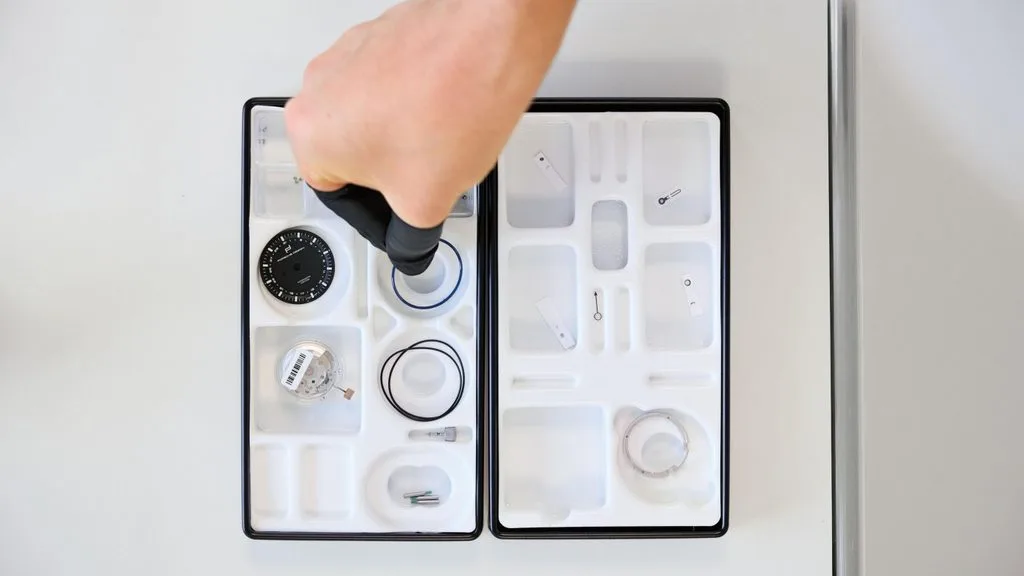
Each workday begins in what the team calls the “supermarket,” a space of neatly organized shelves and drawers. Production Manager Christoph Fröhlicher pushes a cart down the aisles with a list, collecting titanium cases, leather straps, cobalt-blue lacquered chapter rings and tiny containers of screws.
Each filled box holds everything needed for one chronograph, which is often a one-of-a-kind piece. Components earn their place only after meeting Porsche Design’s standards. For chronograph pushers, the Swiss industry standard calls for around 3,000 actuations, while Porsche Design requires a minimum of 10,000.
Configured to Match a Porsche
In the configuration lounge, customers compare color samples matched to their car’s paint and feel leather straps made from the same hides as their sports car seats. Bergmann, who spent years in Zuffenhausen integrating Porsche Exclusive Manufaktur options into production, says his role is to unite the brand’s exclusive sports cars and timepieces.
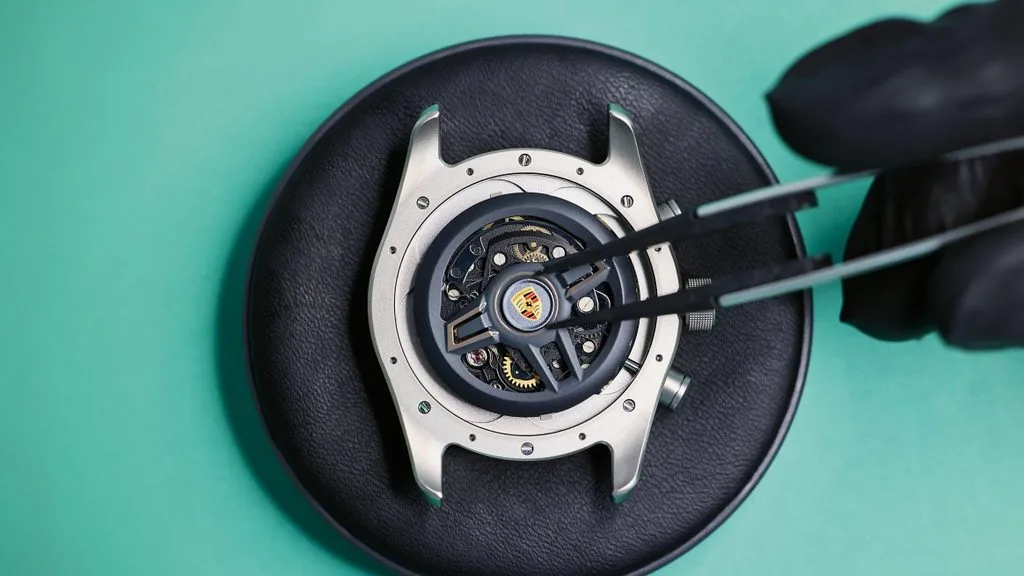
The rotor shows the difference. A car’s alloy wheel must be perfectly balanced, but Bergmann explains that tungsten weights are added to the wheel-inspired rotor to create a deliberate imbalance that keeps the automatic movement wound.
Building a Watch, Step by Step
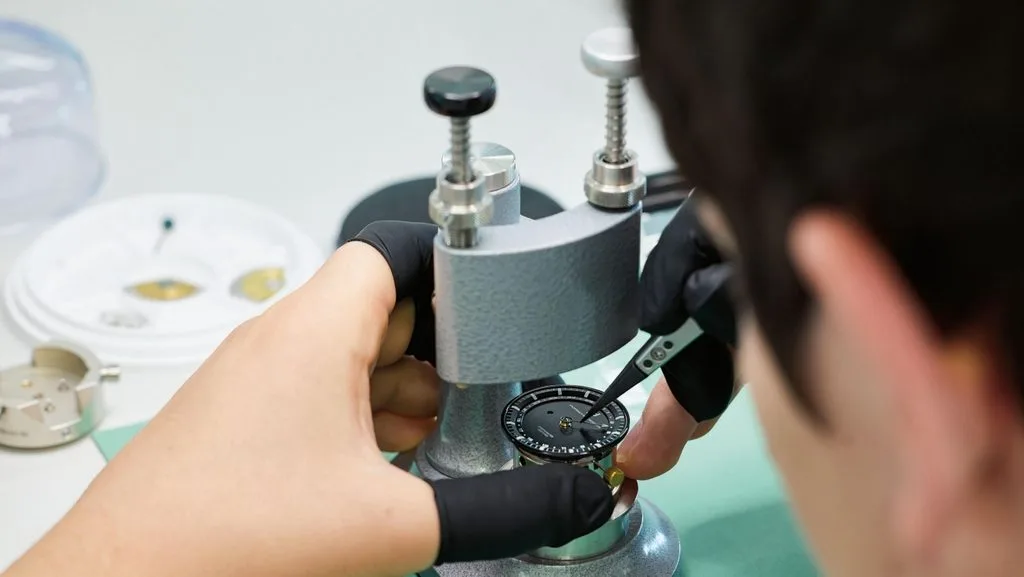
Watchmaker Tobias Schmid collects the box inside the clean room. He first tests the movement’s rate accuracy on a timing machine, then fits the dial and chapter ring and sets the hands one by one with his own tweezers, working from the lowest complications upward. The movement goes into a titanium case, which is checked with compressed air for stray dust before the gaskets are fitted and the case is closed.
Each finished watch then undergoes multi-stage tests for rate accuracy, power reserve and water resistance, followed by an exhaustive visual inspection. Only then does it receive its engraving and the chosen leather or titanium strap.
A Team That Rotates Through Production
Fröhlicher leads a team of ten watchmakers, all trained to perform every step of production. Instead of repeating one task, they rotate through the stages, which Porsche Design says improves quality because each watchmaker understands the standards applied at final inspection.
Fröhlicher apprenticed in Grenchen, and he spent 14 years at a major mechanical movement manufacturer nearby before returning. Bergmann, for his part, says a ticking movement signals quality in a watch, while a ticking sound in a car is one of the least welcome noises.
Grenchen’s Watchmaking Roots
Around 1850, Grenchen was a farming village of about 1,500 residents, and a series of poor harvests had left farmers impoverished. Straw-weaving and silk-spinning failed to provide lasting work, until physician and politician Dr. Josef Girard introduced watchmaking.
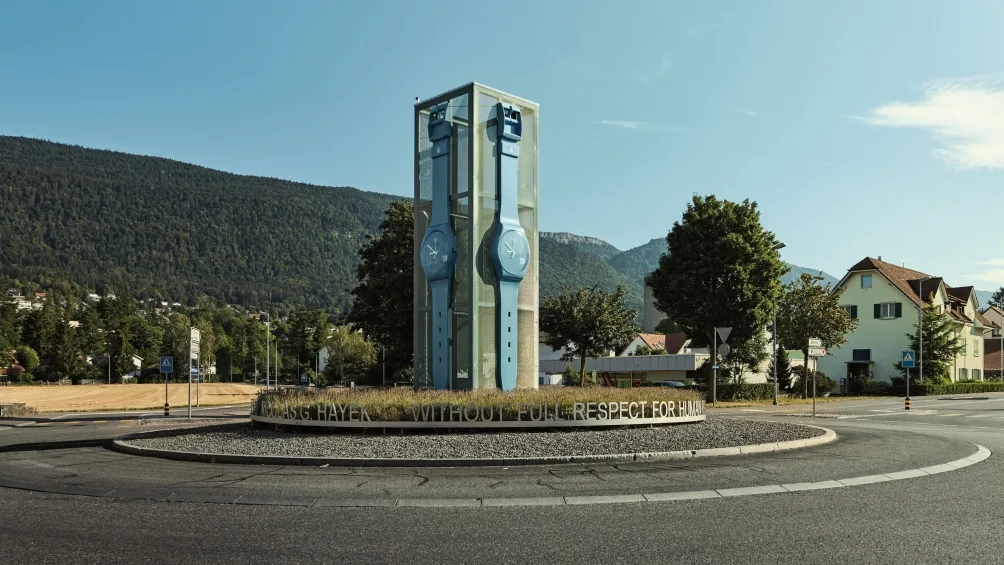
Home workbenches became the town’s first factories, and a century later more than 22,000 people lived and worked there, according to local tour guide Monika Bruder. Today the town’s Museum of Cultural History traces that story across three floors, and a roundabout at the town’s edge features four oversized wristwatches.