
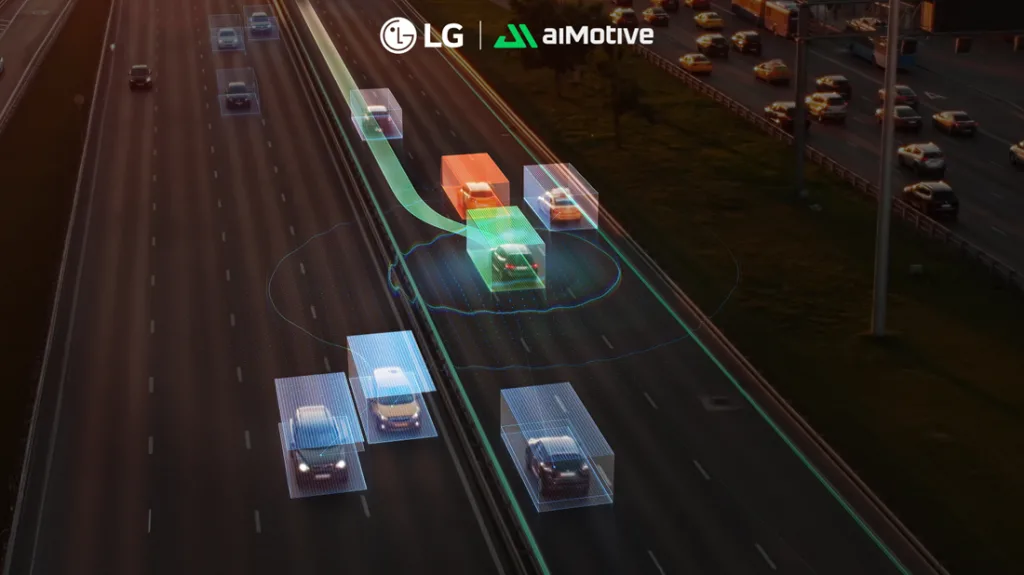
LG Electronics has announced its next-generation High-Performance Computing (HPC) Lite platform, scheduled for debut at CES 2026, representing significant advancement in automotive computing architecture through integration of vehicle In-Vehicle Infotainment (IVI) systems and Advanced Driver Assistance Systems (ADAS) into unified processing infrastructure.
The platform addresses the increasing complexity of modern vehicles that simultaneously serve as navigation guides, safety assistants, and entertainment hubs requiring central systems capable of orchestrating diverse functions with precision and fluidity.
The HPC Lite platform was developed through strategic partnership with aiMotive, a leading automotive artificial intelligence developer and wholly owned subsidiary of Stellantis.
This collaboration combined aiMotive’s expertise in perception algorithms and driving intelligence with LG’s established capabilities in vehicle component development, creating comprehensive solution that consolidates vehicle computing requirements into efficient architecture.
Strategic Partnership with aiMotive Enables Advanced AI Integration
The development of the HPC Lite platform required identifying partners with complementary technical capabilities and strategic alignment regarding software-defined vehicle evolution.
LG’s selection of aiMotive reflected recognition that successful next-generation vehicle computing platforms must incorporate sophisticated artificial intelligence capabilities alongside robust hardware engineering.
aiMotive brings proven expertise in perception systems and driving intelligence algorithms developed through extensive automotive AI research and real-world validation.
As a wholly owned Stellantis subsidiary, aiMotive possesses deep understanding of automotive industry requirements, manufacturing constraints, and validation processes essential for production vehicle deployment.
The partnership structure enabled collaborative development across multiple technical domains including sensor fusion, neural network processing, real-time operating systems, and safety-critical software architecture.
This integrated approach ensured that hardware capabilities and software requirements aligned throughout development rather than requiring subsequent integration of independently developed components.
Gabor Pongracz, Senior Vice President and Head of ADAS/AD Software at aiMotive, emphasized that combining aiMotive’s AI-powered software with LG’s technological strengths enables scalable, reliable, and intelligent solutions for the future of driving.
This characterization reflects recognition that successful automotive platforms must balance performance capabilities with cost competitiveness and manufacturing scalability to achieve meaningful market penetration.
Unified System-on-Chip Architecture Consolidates Vehicle Computing Functions
The HPC Lite platform consolidates multiple vehicle functions into a single HPC Electronic Control Unit built on advanced System-on-Chip architecture enhanced with aiMotive’s aiDrive software suite.
This integration approach contrasts with traditional vehicle architectures employing separate computing modules for infotainment and driver assistance functions, each requiring independent power supplies, cooling systems, and communication interfaces.
By integrating these capabilities within a single SoC, the platform handles substantial data processing demands of software-defined vehicles with enhanced efficiency compared to distributed computing approaches.
The unified architecture reduces component count, simplifies vehicle electrical architecture, and minimizes communication latency between infotainment and driver assistance functions that increasingly require coordinated operation.
For original equipment manufacturers, this consolidation translates to lower component costs through reduced bill-of-materials complexity, decreased hardware integration expenses, and simplified supply chain management.
The unified architecture also facilitates over-the-air software updates spanning both infotainment and driver assistance domains, enabling continuous feature enhancement and issue resolution throughout vehicle lifecycle.
The platform’s architecture incorporates safety-critical design principles ensuring that driver assistance functions maintain operational integrity independent of infotainment system states.
This isolation prevents potential infotainment software issues from compromising essential safety functions while enabling resource sharing for non-safety-critical processing tasks.
aiDrive Software Enables Level 2+ Automated Driving Without HD Map Dependency
The integrated aiDrive solution supports Level 2+ automated navigation-assisted driving on highways and eligible secondary roads, utilizing comprehensive multi-camera and multi-radar sensor configurations that operate without high-definition map dependency.
This map-independent approach addresses significant practical challenges associated with HD map-based systems including map data currency, geographic coverage limitations, and licensing costs.
The aiDrive software stack employs end-to-end artificial intelligence processing that directly interprets sensor data to generate driving decisions rather than relying on precise prior knowledge of road geometry and infrastructure encoded in HD maps.
This approach leverages neural network architectures trained on diverse driving scenarios to recognize road features, traffic participants, and appropriate driving behaviors in real-time.
Level 2+ classification indicates systems providing sustained longitudinal and lateral vehicle control on highways while requiring continuous driver supervision and readiness to intervene.
The “plus” designation typically signifies enhanced capabilities beyond basic adaptive cruise control and lane centering, including features such as automatic lane changes and navigation-based route following.
The multi-camera sensor array provides 360-degree environmental perception enabling comprehensive monitoring of surrounding traffic, road markings, and infrastructure elements.
Multi-radar integration complements camera sensing by providing reliable distance and velocity measurements across diverse weather and lighting conditions where camera performance may degrade.
Intelligent Driving Assistance Features Support Daily Driving Scenarios
The HPC Lite platform provides comprehensive intelligent driving assistance capabilities designed to function as smart companion systems rather than attempting to replace driver decision-making.
This assistance-focused approach aligns with regulatory frameworks and consumer acceptance patterns that maintain driver responsibility while providing supportive intervention.
Traffic light recognition functionality enables the system to identify signal states and locations, facilitating appropriate vehicle responses including deceleration when approaching red lights.
Automatic stopping at stop lines ensures compliance with traffic control devices while reducing driver workload in repetitive stop-and-go traffic conditions common in urban and suburban environments.
Speed adjustment assistance according to highway limits incorporates traffic sign recognition and map-based speed limit data to recommend or automatically adjust vehicle velocity matching posted restrictions.
This capability addresses driver distraction and unfamiliarity with local speed regulations while potentially reducing traffic violation occurrences.
Overtaking maneuver assistance evaluates surrounding traffic conditions to identify safe passing opportunities, providing recommendations or executing lane changes when driver initiates overtaking requests.
The system monitors adjacent lanes, approaching vehicles, and available acceleration to ensure maneuver completion without compromising safety margins.
Yielding assistance for vehicles approaching from behind during lane changes or merging operations addresses blind spot monitoring limitations by actively tracking higher-speed traffic in adjacent lanes and providing warnings or intervention when lane change attempts could result in conflicts.
This functionality proves particularly valuable on highways where speed differentials between lanes create challenging merging scenarios.
Optimized Human-Machine Interface Delivers Intuitive Information Presentation
Advanced technology effectiveness depends substantially on intuitive user interfaces that present information without creating driver distraction or cognitive overload.
The HPC Lite platform incorporates optimized Human-Machine Interface designs specifically developed for next-generation automotive displays, ensuring drivers remain informed about vehicle systems and surrounding conditions while maintaining attention on primary driving tasks.
A unified digital cockpit integrates the instrument cluster and Center Information Display into cohesive information environment rather than presenting disconnected data streams across separate screens.
This integration enables intelligent information routing that presents driving-critical alerts in the instrument cluster while relegating secondary information to the center display, matching information importance with driver attention allocation patterns.
The ADAS Confident View provides intuitive 3D and 2D visualizations of vehicle surroundings, rendering detected vehicles, pedestrians, lane markings, and relevant infrastructure elements in graphical representations that enable quick situation comprehension.
Three-dimensional visualizations prove particularly effective for conveying spatial relationships and potential collision trajectories, while two-dimensional overhead views efficiently communicate vehicle positioning relative to lane boundaries and adjacent traffic.
Essential alerts including following distance monitoring, collision warnings, and real-time traffic-based route suggestions receive prominent presentation ensuring driver awareness of situations requiring attention or intervention.
The interface design prioritizes alert hierarchy to prevent warning fatigue where excessive notifications reduce driver responsiveness to genuinely critical situations.
Beyond safety-critical information, the platform enables presentation of curated lifestyle content including promotions from frequently visited stores and personalized recommendations based on driving patterns and preferences.
This capability transforms the vehicle into connected lifestyle hub while maintaining appropriate boundaries between entertainment features and driving-focused functionality.
Software-Defined Vehicle Architecture Enables Continuous Feature Enhancement
The HPC Lite platform’s architecture positions it as core enabling technology for the software-defined vehicle era where vehicle capabilities evolve throughout ownership periods through over-the-air software updates rather than remaining static at production.
This paradigm shift transforms automotive business models by enabling manufacturers to introduce new features, enhance existing capabilities, and address issues without requiring dealer service visits.
The unified computing architecture facilitates coordinated updates spanning infotainment and driver assistance domains, ensuring system compatibility and enabling features that leverage capabilities from both functional areas.
For example, augmented reality navigation could overlay directional guidance on forward-facing camera feeds displayed through the instrument cluster, requiring coordination between navigation software and camera processing.
Software-defined architectures also enable differentiation through feature activation rather than hardware variations, allowing manufacturers to offer tiered feature packages and potentially subscription-based services that generate recurring revenue beyond initial vehicle sales.
This approach provides consumers with flexibility to adjust vehicle capabilities matching evolving needs without requiring new vehicle purchases.
The platform’s efficiency in managing complex vehicle functions positions it competitively for software-defined vehicle applications where processing demands continually increase as manufacturers introduce enhanced features and more sophisticated algorithms.
Scalability considerations ensure the architecture accommodates future capability expansions without requiring fundamental redesigns.
Continued Collaboration Targets Tailored Solutions for Global Automakers
LG and aiMotive’s ongoing partnership will focus on delivering tailored solutions for global automakers, combining high performance with cost competitiveness to address diverse market requirements.
This customization capability recognizes that automotive manufacturers serve different market segments with varying feature requirements, price positioning, and regional regulatory considerations.
The collaboration’s emphasis on cost competitiveness alongside performance reflects understanding that mass market adoption of advanced driver assistance and infotainment capabilities requires pricing structures accessible to volume vehicle segments rather than limiting availability to premium products.
Achieving cost targets while maintaining performance requires careful optimization across hardware selection, software efficiency, and manufacturing processes.
Tailored solutions may encompass sensor configuration variations, feature set adjustments, and regional customizations addressing specific market preferences and regulatory requirements.
This flexibility enables manufacturers to deploy the HPC Lite platform across diverse vehicle programs while maintaining appropriate cost-benefit relationships for each application.
Strategic Positioning as Leading IVI and ADAS Solutions Provider
Eun Seok-hyun, President of LG Vehicle Solution Company, characterized the HPC Lite platform launch as an important milestone that further solidifies LG’s role as a leading provider of transformative IVI and ADAS solutions.
This positioning reflects LG’s strategic emphasis on automotive components as growth opportunity as consumer electronics markets mature and automotive industry undergoes fundamental technology transition.
The platform builds on the original HPC system unveiled at CES 2025, demonstrating rapid iteration and capability enhancement that maintains competitive positioning in fast-evolving automotive technology landscape.
The progression from first-generation to HPC Lite within one year indicates aggressive development timelines necessary to maintain relevance as automakers evaluate platform selections for upcoming vehicle programs.
LG’s characterization of the platform as capable of “redefining the drive” and taking driving comfort and convenience to new levels reflects ambitious objectives regarding user experience transformation.
Achieving these objectives requires not only technical capability but also thoughtful feature implementation that delivers genuine value rather than merely impressive specifications.
Market Context and Competitive Dynamics in Automotive Computing Platforms and CES 2026
The HPC Lite platform enters an increasingly competitive market for automotive computing solutions where traditional tier-one suppliers, semiconductor companies, and technology firms compete for platform adoption by global automakers.
Established competitors include Bosch, Continental, Aptiv, NVIDIA, Qualcomm, and others with varying approaches to integrated vehicle computing.
Successful platform adoption depends on multiple factors beyond pure technical performance including manufacturing track record, automotive quality and safety validation, supply chain reliability, pricing competitiveness, and strategic relationships with automakers.
LG’s established automotive supply relationships and manufacturing capabilities provide advantages in these areas compared to pure technology companies entering automotive markets.
The timing of the CES 2026 debut positions the platform for consideration in vehicle programs with production launches beginning in 2028 or later, assuming typical automotive development timelines.
This timing aligns with increasing automaker adoption of software-defined vehicle architectures and Level 2+ driver assistance features becoming expected rather than optional capabilities in mainstream vehicle segments.
Market success will depend substantially on securing design wins with major automakers for significant vehicle programs.
Platform selections typically involve multi-year evaluation processes considering technical capabilities, business terms, and strategic alignment, making early announcements important for entering consideration but not guaranteeing commercial success.